
- Home
- AUTHOR INTERVIEWS- CHECK THEM OUT
- In Conversation with Kirk Ward Robinson: Timeless Lessons from “Hiking Through History: Hannibal, Highlanders & Joan of Arc
In Conversation with Kirk Ward Robinson: Timeless Lessons from “Hiking Through History: Hannibal, Highlanders & Joan of Arc
- By Norm Goldman
- Published February 24, 2026
- AUTHOR INTERVIEWS- CHECK THEM OUT

 Norm Goldman
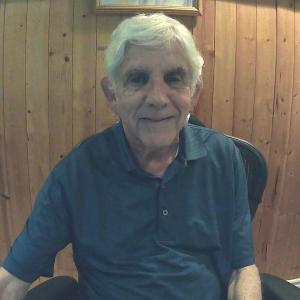
Reviewer & Author Interviewer, Norm Goldman. Norm is the Publisher & Editor of Bookpleasures.com.
He has been reviewing books for the past twenty years after retiring from the legal profession.
To read more about Norm Follow Here
Bookpleasures.com is delighted to introduce Kirk Ward Robinson, a four-time Appalachian Trail thru-hiker, seasoned cyclist, and acclaimed novelist whose adventures have shaped both his worldview and his stories.
Hailing from the Rio Grande Valley of South Texas and now tending a family farm in Tennessee. Kirk’s journey has taken him through roles as diverse as nonprofit leader with the National Park Service, bookstore manager, and bicycle mechanic.
His books have earned praise from Kirkus Reviews, Foreword Clarion, LitPick, Feathered Quill, and One Tribune Media.
Today, we have the pleasure of discussing his latest book, Hiking Through History: Hannibal, Highlanders & Joan of Arc, with him.
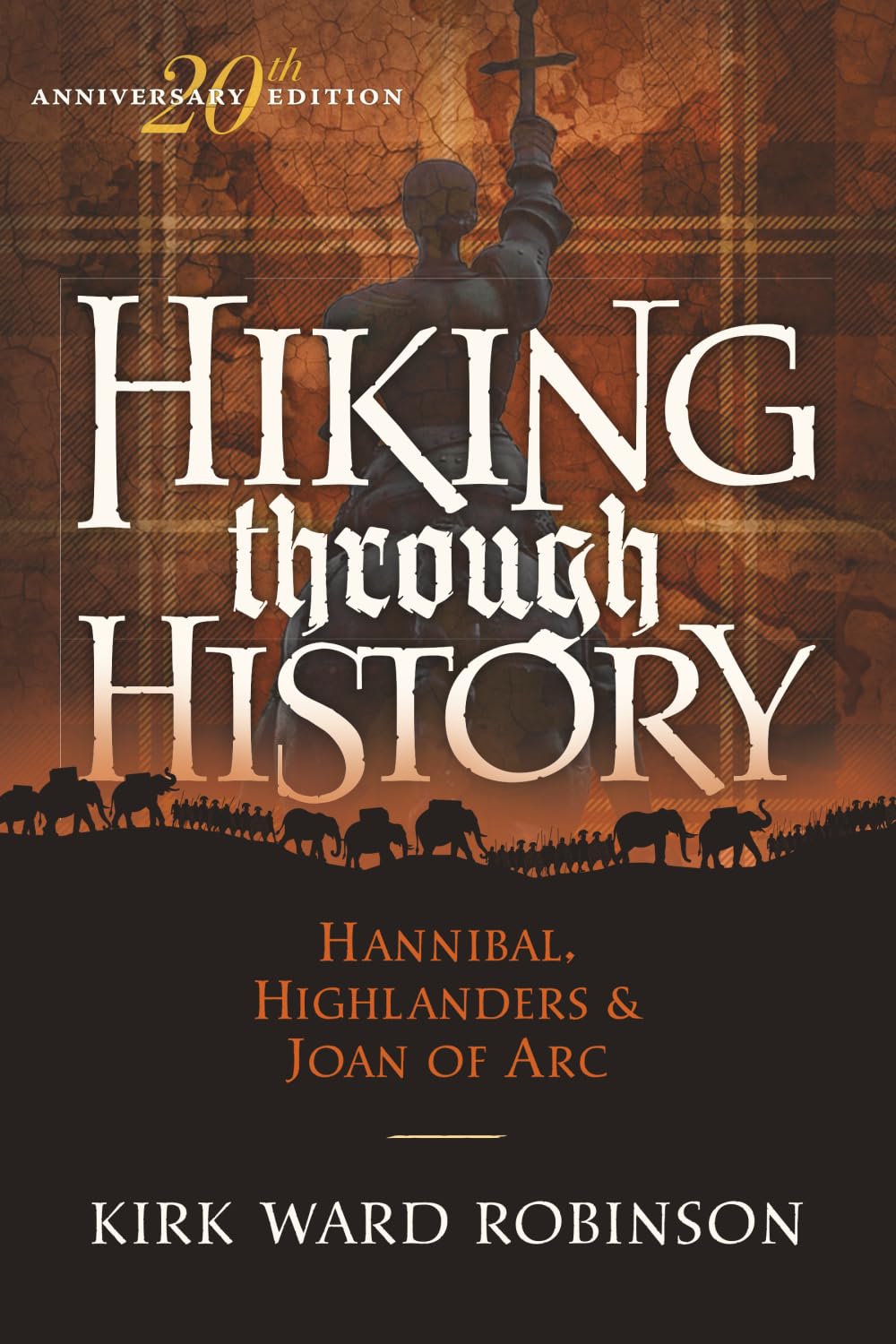
Good day Kirk and welcome once again to bookpleasures.com
Norm: In the preface of Hiking Through History: Hannibal, Highlanders & Joan of Arc, you note that this edition reflects 20 more years of writing experience and travel.
If you were writing Hiking Through History from scratch today, what is one major structural or compositional choice you would do differently, and what is one thing you’re glad you did exactly as you did in 2005?
Rick: Hi, Norm. It’s great to be with you again. I’m honored to be invited.

That’s a difficult question to answer, Norm. If I did the book today, of course there is much more information available now. I’ll explain as we go. But at the same time, my journey in 2005 couldn’t occur today.
If I were disembarking from Galveston, Texas today, I would be armed with all the apps I would need to have a seamless, plastic experience. I didn’t have that in 1998 or 2005, and that’s what I think made those journeys so impressionable to me personally.
Spontaneity is difficult these days since millions of other people have done the same thing and have posted it to their social media. This would be much like asking Twain how he would write Huck Finn differently if he were writing it now rather than in the nineteenth century.
I structured the book based upon my experiences and my personality, which some consider eccentric, others just plain old-fashioned. I wanted to set it up as a story, where peculiarities are revealed then explained in later passages.
I thought this worked then and now to make Hiking Through History more than just a travel memoir. But I’m older now, presumably wiser, so probably would have moderated some of my criticism.
Norm: The book constantly compares fast current travel with your preference for moving “at the pace of the sun.” Has there ever been a moment on the road when you regretted not choosing the fast, efficient option—and what did you learn from that regret?
Rick: This might disappoint, but no. The only time I want to hurry things up is when I’m stuck in rush hour traffic in Nashville, which has gotten progressively worse ever since that TV show (oh, and a few of those trains in France, but really, I was short of cash).
I drive 80 miles round-trip for groceries, and I enjoy every mile of them, at the speed limit, of course.
I explore new routes, see new things. It’s an inconvenience, but convenience doesn’t make memories, convenience make routine.
Even now, if I was offered a berth on Elissa, the official tall ship of Texas, making sail for Europe, I would sign on and clean privies if that’s what it took. I wouldn’t offer that on a 747.
I will say this, if we had the technology to accelerate to Mars at one gravity, we could be there in three days and that would be something.
Norm: The transatlantic voyage on Galaxy is almost its own novella before we ever reach Hannibal’s world. How intentional was that long ocean prelude structurally? Did you ever consider starting the book “cold” in Europe and relegating the ship chapter to a separate work?
Rick: Norm, you have to step back in time to Windows FrontPage, which is what my website was then. I was posting field notes daily. As a matter of fact, one of the reasons that voyage happened was because they offered me free internet.
Before I was writing travel books, I was writing long posts on my website, mostly for family and friends but I did have a few followers, who weren’t called followers then.
These organized themselves chronologically, and that’s the way the way the book rolled out, with the exception of Scotland Wha Hae, which I included to give Hiking Through History some heft. I never anticipated that the voyage would be so rich.
With dozens of posts, I discovered later that I had enough material for an entire section of the book, so I included it because it was part of the experience.
Norm: You’re hard on yourself and sometimes on others (e.g., some students, some fellow passengers, some French encounters), but usually in a comic key.
When you revised for this 20th anniversary edition, did you tone anything down (or decide not to tone things down) because your view of those people, or of your younger self, had changed?
Rick: No. I push myself hard. Then and now. My mother used to chide me for this, and since, many companions on the Appalachian Trail, who have never understood why I wanted to push for thirty miles in a day. A minute chilled is one you can never get back. I am in tune to mortality.
I wanted the original edition to be an honest reflection of my experiences, my faults, and possibly my virtues, and I saw no reason to change that with this new edition. Readers can scold me or congratulate me. I’m accustomed to both.
Norm: The Hannibal sections alternate between very granular route-finding (Ebro, Rhône, Drôme, Col de la Croix) and broader historical reconstruction.
When the ancient sources were vague or contradictory, what was your process for deciding, “This is the route I’m going to walk and treat as most likely”?
Rick: I had to make Hannibal a character. When I write a fictional character, I get into character as if I am that person. I mean this and it can be emotionally draining, but it has delivered me some exceptional characters on the page.
For Hannibal, you might say I was channeling him. I looked at the Rhone, I hiked it (and sadly in a car for part of it). I saw the way the rivers came in. I knew how far behind the Romans were, how long my column of march was, and I thought: If I were leading this army, I would turn here and make for the mountains.
Norm: You’re candid about language obstacles and cultural friction, especially in France and later in Italy with dialects: Looking back, is there some specific interaction you wish you could redo with your current language skills and cultural experience—and what do you think would play out differently?
Rick: My difficulties with Piedmont Italian were brief and have not troubled me. Rather, I find those dialects fascinating. I wish I’d spent more time there to learn them. Beyond that, I think I would be more patient with the French now. My pique and impatience cost me Orleans, which I’ve never revisited, and Orleans is rich with Joan of Arc. I sometimes think that if I’d just hiked the five miles to the campground, pitched tent and slept on it, I might have returned to Orleans the next day, refreshed and ready to endure for a while. My goodness, what I would have experienced if I had.
Norm: The book is as much about friendship as it is about history—Nymous, Hans and Dagmar, Chad and Shawna, Didier and Carole, Andrea, etc.
Were there any key relationships from these journeys that you didn’t include, or that you decided to anonymize or protect more carefully in this edition?
Rick: No. The only anonymous character is Nymous, a friend going back five decades but for reasons inexplicable he didn’t want his name mentioned. I still don’t understand. Everyone else was thrilled, and have helped drive sales of my book in Europe.
And I’m still in touch with all of them today, except for Andrea, who somehow slipped away a few years ago and I haven’t been able to track her down. Probably because I don’t do social media.
Norm: Your treatment of Hannibal is notably sympathetic, even admiring, despite the brutality of Saguntum, the Alpine march, and Trasimene.
After walking so much of his path, did your moral judgment of Hannibal change at all, or did the physical experience mainly deepen your comprehension rather than your evaluation?
Rick: Remembering that all the histories we have were written by the victors, I have to interpret Hannibal by what he achieved. No one else has done it since. Really. So he must have been more than a beast.
His army was made up of mercenaries, not patriots as we would expect today. He couldn’t possibly have kept these men with him if he hadn’t possessed something that Roman historians have omitted. As for the brutality, so what’s new about that?
We do it now, I need not mention where. We are evolved socially, yet it still goes on. In Hannibal’s time, this is the way it was.
There was no moral circumspection back then because it had never been practiced or implied, by the Romans, the Carthaginians, the Persians, the Egyptians, or Leonidas and his 300. Cliff dwellings were built in the desert southwest for reasons other than the view.
This is the sorry side of the human condition, but it’s what we’re stuck with. I admire Hannibal for what he accomplished. After tracing his route on foot, I admire him even more.
Norm: In Cartagena and Sagunto, especially, you highlight how little visible Carthaginian material remains compared to the Roman layers. As a writer, how did you think about “re-materializing” a largely erased civilization on the page without drifting into historical fiction?
Rick: This might seem less than credible, but I truly do feel the weight of history. It’s like a lodestone drawing me toward it. In Cartagena and Sagunto I could feel it, and in my mind I could project what once was millennia ago, reconstructing it all until it stood new before my eyes.
This is supplemented by my study, so it isn’t all just fantasy. I did see the Muralla Punica in Cartagena, a wall 2245 years old as of this interview. I didn’t touch it because of my leave no trace ethics, but now I wish I had. Nevertheless, that wall gave me a tangible image of those times.
Norm: The book keeps circling questions of identity—American, German, Italian, Catalan, Gaulish, Carthaginian—and how language both preserves and erodes it.
After all these miles and conversations, do you feel more strongly attached to your own American/Texan identity, or more skeptical of national identities in general?
Rick: I feel closer. Our languages, and the way we speak them, are our culture, our identity. I am originally from Texas and I speak like a Texan—specifically, a Texan from the south of that state. People in Dallas use different terms and inflections.
The same with Houston, the Hill Country, the Panhandle, and out west in the Trans-Pecos. I’ve been living in Tennessee many years now. There is a twang here that I haven’t incorporated into my speech, but I’ve used it in my Speaks Saga novels to create authenticity. In our fractured society, we can lose stories and family traditions, but the way we speak tells us where we’re from.
Remember, even Rick, the Kiwi in Scotland, could tell where I was from because of my accent.
Norm: By pairing Hannibal, Highlanders, and Joan of Arc, you implicitly connect very different wars, landscapes, and cultures.
What single through line—moral, psychological, or thematic—most surprised you as you moved from Carthaginian Spain/Italy to Scotland and then to Joan’s France?
Rick: That everything is so much the same. We are all human regardless our period and place. We share the same ideas and dreams, sometimes the same cruelty, and sometimes a profound nobility.
It’s the nobility I wanted to explore, and I found it, in the then and the now.
Norm: Where can our readers find out more about you and Hiking Through History: Hannibal, Highlanders & Joan of Arc?
My website, of course, www.kirkwardrobinson.com. Readers intrigued enough might take on my Notes from the Field series, starting with Notes from the Field: A Diary of Journeys Near and Far. In that book, they will read the original field notes that became Hiking Through History.\
Norm: As we finish up our interview, you’re clearly conscious of being an American abroad in the early 2000s, with Iraq and the “Bush years” in the background of some conversations.
If you repeated these same journeys now, in the mid 2020s, what kinds of political or cultural conversations do you suspect would replace those, and would you write about them differently?
Rick: Gosh, are we almost done? I was just getting started (smiley face implied). Look, Norm, you know what’s going on right now, and I’m still in contact with friends in Europe, who are gobsmacked. “Why did you let this happen?” they ask me.
This is so much worse that there’s no comparison to what we thought was unforgivable back then. I suspect that any solo unsupported journey to Europe (or elsewhere) today would be met with derision.
I would write the truth regardless, but many of those conversations would be much more heated, to the point that I would probably avoid people altogether, and what good is that?
Norm: Thanks once again and good luck with all of your future endeavors
Follow Here For Norm's Interview With Kirk Ward Robinson