
- Home
- AUTHOR INTERVIEWS- CHECK THEM OUT
- Short Stories That Resonate: John Moen Discusses Themes, Inspiration, and Personal Connections
Short Stories That Resonate: John Moen Discusses Themes, Inspiration, and Personal Connections
- By Norm Goldman
- Published May 17, 2024
- AUTHOR INTERVIEWS- CHECK THEM OUT

 Norm Goldman

Reviewer & Author Interviewer, Norm Goldman. Norm is the Publisher & Editor of Bookpleasures.com.
He has been reviewing books for the past twenty years after retiring from the legal profession.
To read more about Norm Follow Here
Bookpleasures.com welcomes as our guest John Moens, author of Never Saw It Coming.
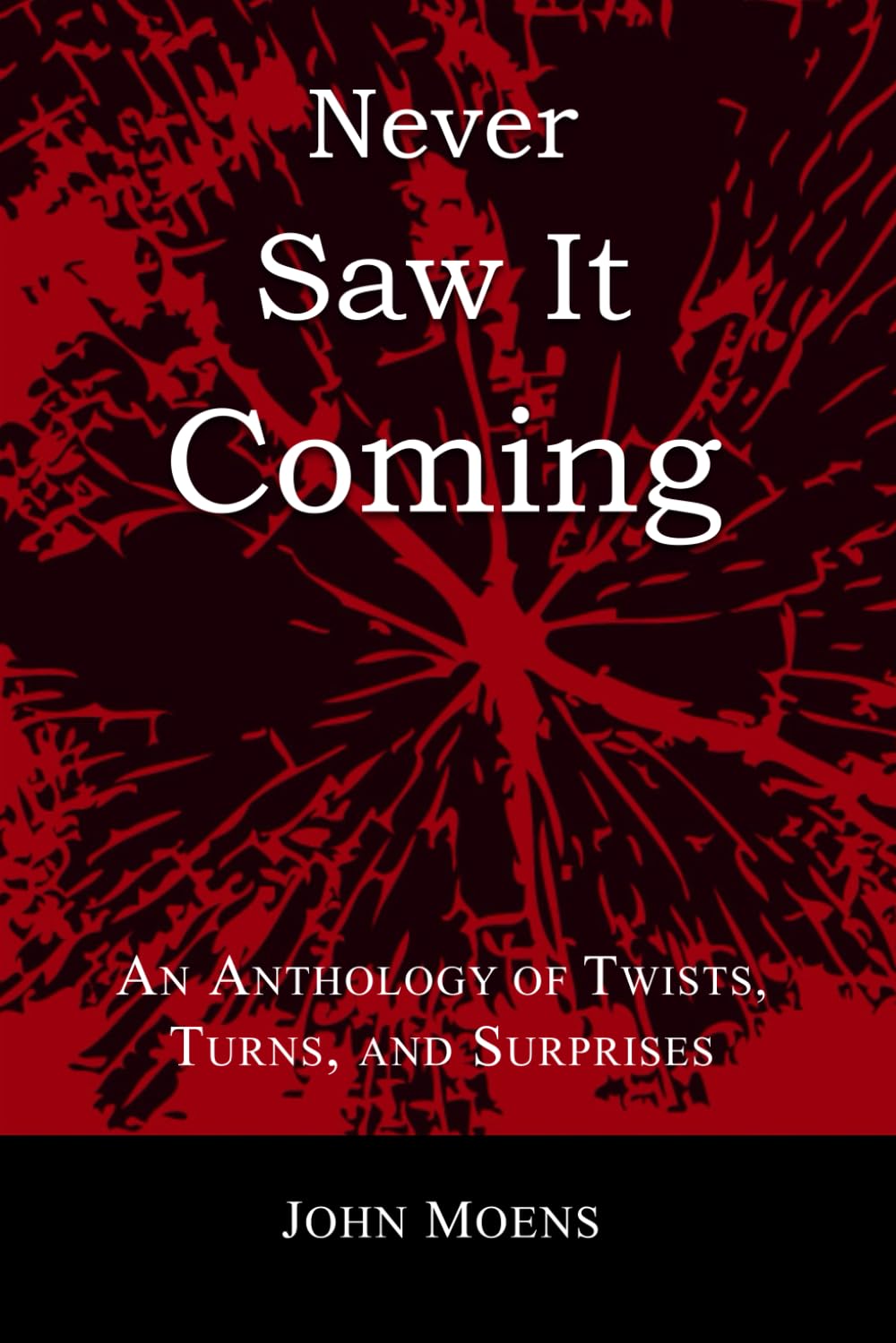
John has been writing short stories since childhood, driven by a love for storytelling rather than financial gain.
As a history major at The Ohio State University, he began collecting interesting facts, which inspired several stories in this collection.
With a glint of mischief in his eye and a profound storyteller's finesse in every gesture, John crafts a tapestry of tales that beckons readers into realms of intrigue and wonder.
Good day John and
thanks for taking part in our interview.
Norm: What
inspired you to write "Never Saw It Coming" and how did you
decide on the themes for the five sections?

John: Upon retiring, I rejoiced in the assumption that I would spend the rest of my days indulging my great passion, writing fiction. Surprisingly, it was several years before I wrote my first short story, "The Arctic Fox" (included in the book).
The story was literally dreamed up by me. I knew nothing about this animal and was astonished to find that the dream appears quite accurate.
Since then, I have written
186 short stories and am working on a novel. With a few
exceptions, each section emphasizes an aspect of my life:
(e.g., I was a history major at Ohio State University, I relate well
to animals, I have had bizarre experiences that I can't explain, and
I have lost loved ones through crime).
Norm: Your ability
to shift tones between stories is impressive. How do you approach
writing in different tones while maintaining a cohesive voice
throughout the anthology?
John: If I knew, I would
write a how-to book. It is a gift I have done nothing to
earn or deserve. There is a limit on gifts, however.
A manager told me, "you write like most people talk and you talk
like most people write."
He explained that most
people get right to the point when talking (maybe not true) and
wander aimlessly when writing. In truth, I am not a great
speaker.
Norm: Many of your stories have thought-provoking
morals. How do you balance conveying a message without making it feel
overt or didactic?
John: My mother
raised me in the Methodist faith, but I often struggle to keep my ego
in check. A supervisor once told me I need to develop some
arrogance to get ahead.
I recall, however, what happened to one of Al Capone's rivals when "his head got too big for his hat." I am not a saint, but I have run into some and I try to follow their example.
"Noles," however, goes to the opposite extreme. I tried to envision what kind of man would follow an order to go into a swamp and kill people so the government could literally steal their land.
If someone runs across a
source that says these soldiers were paragons of virtue, I am not too
proud to acknowledge I might be mistaken.
Norm: What
role did your background as a history major play in shaping the
stories within this collection? Can you give an example of a
historical fact that inspired a particular story?
John:
I can give many examples. Paddys Hens and Chickens is a true
story. Four of my ancestors were at Andersonville prison, the
starting point of many of the "Sultana's" passengers.
I don't know if any of them were on the vessel, but that's what drew my attention. I recently met someone whose grandfather was aboard it.
Her grandfather told her that most of the deaths were from scalding water. I submitted an unpublished article for "Military History" magazine on the American Intervention in Russia (Re: "The Polar Bears").
The editor noted it was well written. I forget where I first read about the tragic accident that killed President Pierce's son (Lady in the Dark) but the story haunted me ever since.
It foreshadows the tragedy of the Civil War. Pierce's efforts to avoid war through compromise helped to ensure war. "It Began as an Ordinary Day" was inspired by my research on American energy.
The first commercial oil well was drilled in Pennsylvania, but salt wells were polluted by oil since the previous century. "Evil" is based on fact.
I originally wrote a
version as a play for a class. The character was so evil that
writing the play frequently gave me headaches and I had to set it
aside now and then. The short story is a watered-down
version.
Norm: How do you think your childhood love for
storytelling influenced your writing style and the themes you explore
in "Never Saw It Coming?"
John:
Storytelling can be a form of escape. Childhood is often
pictured as an idyllic time of innocence. For many people,
however, it is a time of insecurity and fear.
Stephen King has been very
effective in portraying that. Unfortunately, his movies are
going beyond the fear to graphic portrayals of torture.
Some
of the stories in my anthology are tough to get through, but in each
of them, I leave children alone. They have enough
troubles.
Norm: Which story or character in the
anthology do you feel most connected to, and why?
John:
I do not feel especially connected to any particular character but
there is a personal experience in many stories. For example, in
C not K, the protagonist brings has a lump of coal in his hand after
mining accident.
It is the only coal brought out that day. When I toured the Metiki coal mine in Maryland, I saw a long wall machine that cuts coal from the walls. A storm knocked out the power and we had to leave.
I mentioned to the foreman that if I applied for a job I could show I brought out a piece of coal. He nodded at the long wall operator and said, "That's more than he did."
"Fifty Words" is one of my most popular stories and possibly the most closely related to personal experience.
But although I was a student in and eventually a tutor of freshman English at The Ohio State University, no such writing assignment was made.
Many of the stories are written in first person, but the only published story entirely from personal experience is "The Tie" in the Writers Group anthology "The Restless Pen." Readers can access it for free on Amazon Kindle.
It was not written to
entertain but to help people deal with death: either their own
or a loved one. As for the surprise ending, I was the one
surprised.
Norm: The story "USELESS"
involves themes of resilience and finding purpose. How do you think
these themes resonate with readers in today's world?
John:
A manager told me I was "the most resilient person" he ever
met. Life is full of setbacks and obstacles and I tried to
follow my father's philosophy of, "Stop feeling sorry for
yourself and get on with your life."
I did run into a roadblock when all the tragedies I set aside came back to haunt me. I needed help to deal with it. If people don't remember anything else I write, please r remember this: "If you need help, don't regard it as a sign of weakness.
Get it."
"Useless" is another story within a story. I like to
challenge myself. Could I write an entire story based on a
single word? The easy way would have been to write a story
about John Wilkes Booth, because it was the last word he uttered as
he lay dying. I never owned a horse or worked on a farm,
but I did learn first hand what horses can do to a karate
demonstration if you put them at the head of a parade.
Norm:
Where can our readers find out more about you and your
writing?
John: I will furnish information on my
author page on Amazon and I definitely plan to come knocking on your
electronic door again.
I am very impressed and grateful that you have put in so much work.
I feel like I know you, although
we have never met.
Norm: What is next for John
Moens?
John: The Writers Group will be publishing
three anthologies: "Poetry," "Do Animals have
Souls?," and "Treasure Chest." I plan to
contribute stories for the latter two.
Simultaneously, I am working on my first historical novel, "Hell and Texas."
The 'underground railroad,' a term applied to the various routes escaping slaves in the followed to get to freedom in Canada, is the theme of books, television and movies, and plays.
This novel features the
less publicized "underground railroad' from Texas to Mexico: a
shorter distance but filled with hazards. Although the
characters are fictional, nearly all of the twists, turns, and
surprises were created by history.
Norm: As we end our
interview, what advice would you give to aspiring writers who aim to
create compelling short stories with strong moral
undertones?
John: Every person has a story:
love, grief, betrayal, struggle, joy. Even boredom can make a
great story. How does one deal with being trapped in a
windowless office in a job with no future, struggling to support a
family?
Don't trap your feelings
inside. Tell your story aloud as if you are
relating it to a friend and record it. Then use it as the basis
of your writing. It might not be a bestseller, but your story
will live on. In a way, you will live on.
Norm:
Thanks once and good luck with all of your future endeavors
Follow Here To Read Norm's Review of Never Saw It Coming