
- Home
- AUTHOR INTERVIEWS- CHECK THEM OUT
- Abortion Division: Bridging the Gap in a Polarized Debate. An Interview With Blake Michael Thulin, author of Abortion Division: Why Americans Disagree on Such a Fundamental Issue of Rights
Abortion Division: Bridging the Gap in a Polarized Debate. An Interview With Blake Michael Thulin, author of Abortion Division: Why Americans Disagree on Such a Fundamental Issue of Rights
- By Norm Goldman
- Published August 28, 2023
- AUTHOR INTERVIEWS- CHECK THEM OUT

 Norm Goldman

Reviewer & Author Interviewer, Norm Goldman. Norm is the Publisher & Editor of Bookpleasures.com.
He has been reviewing books for the past twenty years after retiring from the legal profession.
To read more about Norm Follow Here
Bookpleasures.com is
excited to introduce Blake Michael Thulin, author of Abortion
Division: Why Americans Disagree on Such a Fundamental Issue of
Rights.
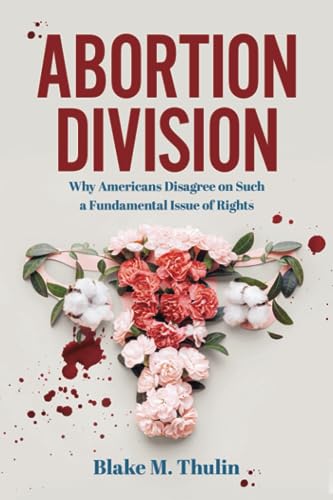
What initially started as a research paper during Blake's law school years quickly developed into a deep investigation of one of America's most hotly contested topics.
Blake's exploration
resulted in his recognition of the crucial demand for an impartial
and evidence-based manual to explain the complex array of
perspectives concerning public policies on reproduction and the
constantly changing domain of women's decisions.
Blake's
academic journey, spanning a BS in Business Administration from CSU
Bakersfield and a JD from the Santa Barbara College of Law,
highlighted the importance of credible sources and unbiased evidence.
Armed with these critical tools, he meticulously transformed
his research into the comprehensive masterpiece known as "Abortion
Division."
This book adeptly navigates the intricate
intersections of legality, medicine, and ethics within the abortion
discourse.
Beyond his literary
pursuits, Blake channels his energy into mixed martial arts training,
trading card collecting, and an insatiable appetite for non-fiction
literature.
Good day Blake and thanks for taking part in our
interview.
Norm: What inspired you to write a comprehensive
guide on the divisive topic of abortion?

Blake: After witnessing several discussions between pro-life and pro-choice advocates, I noticed that both parties had a tendency to talk past one another, especially when it came to issues regarding individual human rights or the law.
Further, I was concerned that there was not a generally agreed upon set of facts from which both sides could argue.
Rather than write a book trying to convince others to think the same way that I do, I decided to take a neutral approach and focus on revealing the thought processes for each respective side and then apply those to a comprehensive set of accepted facts.
My goal is to facilitate
communication and understanding between both sides.
Norm:
Engaging in discussions about abortion can be emotionally charged.
How does your book guide readers in maintaining a respectful and
productive discourse, even when opinions differ?
Blake: In
the book, I discuss how argument and debate are rarely effective in
changing one’s mind.
These formats are often adversarial in nature, and very few people change their mind especially when someone else is intentionally making them angry by trying to “own” them with facts.
The focus is on a mutual
understanding of the good-faith motives each side has for pursuing
their position.
Norm: Could you discuss how your book is
tailored for an audience with no background in law and how it helps
them navigate the intricate legal aspects of abortion?
Blake:
The Roe v. Wade can be particularly difficult to understand if you do
not have a legal background.
To help ease the learning process, I introduce the main legal principles of substantive due process and the right to privacy through the earlier case Griswold v. Connecticut, and then use that as a launching point to discuss Roe.
I also dig into cases cited by Justice Blackmun in Roe to provide a comprehensive analysis of the case and his reasoning for the majority opinion.
Norm: Could you
elaborate on the challenges you faced in maintaining an unbiased
perspective while discussing such a sensitive and emotionally charged
subject?
Blake: When writing the initial drafts of this
book, I made an effort to provide counter-points to each point that I
believed in.
I know what my positions on this subject are. I also know what the most effective counter-arguments to my position are. By presenting these side-by-side, I am able draw the focus away from my personal beliefs and represent both positions in their best light.
That being said, I do occasionally use humor to attack both positions as well. Since this is a rather serious subject, some comedic relief helps prevent the book from being too dark and depressing.
I never make fun of women
who are dealing with the emotional struggle of an unwanted pregnancy,
but I do take shots at the academic aspects of the law, medicine, and
ethics surrounding the issue.
Norm: In your book, you
mentioned the evolution of abortion law. How has this historical
context contributed to the current debate in America?
Blake:
I’m going to answer this question a little differently. It
seems to me that much of the current debate regarding abortion comes
from the context of a post-1960's moral perspective.
It is normal for us to think of abortion in terms of women’s rights, but this was not always the case. For example, in the Roman Empire, it was the patriarch of the family that got to decide if the pregnancy was unwanted or not.
Much of this was based on economic motivations. Children that were born notably deformed were actually required to be killed by Roman law, regardless of the wishes of the mother.
The concept of the unborn having a moral attribute comes from the Judeo-Christian tradition, from which the modern pro-life position originates.
But as society culturally moves away from this tradition, there are debates on how exactly the value of human life should be measured and whether or not it should be protected.
We live in an interesting
time as the popular culture seems to be moving towards the pro-choice
position, while the law moves towards the pro-life side.
Norm:
Could you provide some insights into the case analysis of Roe v. Wade
and the specific shortcomings that you believe led to its recent
overturn?
Blake: When we think of constitutional
checks and balances, the Judiciary is often an overlooked branch of
government. Over the years of its existence, it appears that
Supreme Court has been struggling with the precise definitions and
boundaries of its power.
Both Griswold and Roe demonstrate this point precisely. The right to privacy never explicitly appears in the text of the Constitution.
However, an expansive reading of the Fourteenth Amendment’s due process clause, the Fourth Amendment’s prohibition against unreasonable searches and seizures, or the Ninth Amendment’s recognition of other rights not enumerated by the Constitution can be used by the court to recognize rights and overturn state laws violating those rights to privacy.
The problem with this approach is that it gives the Court almost unlimited power to overturn laws enacted by States through their respective democratic processes.
When Roe was decided, the majority essentially stated that there was a right to privacy found somewhere in the Constitution and this right protected abortion.
This decision also disrupted the traditional role of States in determining issues of life and death, such as the legal recognition of the beginning of a human life and the circumstances in which it was legal to take a life.
An example of this role can be seen in how the different states pass different laws regarding the death penalty, assisted suicide, and similar matters.
Although many opponents of the recent Dobbs v. Jackson Women’s Health Organization case may claim that the Court is engaged in a power grab, it is actually quite the opposite.
The Supreme Court is surrendering a power that it previously wielded against the States and returning that law-making capability back to the state legislatures.
Norm: Moral
psychology plays a significant role in public perceptions of human
rights. How does your book explore this aspect in relation to the
abortion debate?
Blake: Jonathan Haidt is moral
psychologist who argues in his book The Righteous Mind that
moral intuitions are an evolutionary adaptation designed to help the
human species overcome specific survival challenges throughout the
course of our existence.
I take his Moral Foundations theory, specifically as it applies to the Sanctity Foundation, and apply it to the issue of abortion.
Those who have a high level of the sanctity intuition typically view life as starting at conception and seek to impose maximum protections.
Those who have absolutely
no concept of sanctity will often use ethical hedonism in order to
make moral calculations. Ethical hedonism is the idea that
feeling pleasure is good, feeling pain is bad, and applies these
principles to all conscious beings.
Norm: Given the complex
intersection of medical ethics and abortion, how do you address the
nuances of this issue in your book?
Blake: After laying
out the Sanctity Foundation, I then discuss in detail what each
abortion procedure actually is. One of the main issues that
requires this nuance is the subject of fetal pain.
As conscious beings, pain seems relatively straight forward. But pain is actually composed of two components. First, there is the detection and transmission of “pain” through the process of nociception.
Nociceptors are specialized nerve endings that sense what we generally think of as pain. These signals are then transmitted to the brain.
However, in order to truly experience pain, we must combine the nociception with conscious perception. This is where things get complicated.
Although we have a decent understanding of the human brain, when it comes to consciousness, especially in fetuses, it is a totally different matter.
We don’t have any kind of general agreement as to when nociception in a fetus becomes wrong. You can compare this to how humans treat the pain of animals.
Is meat or dairy or egg
production causing pain to animals that we would consider to be
wrong? Can something be wrong even if pain is absent?
Norm:
The book aims to equip readers with effective argument strategies for
both Pro-Life and Pro-Choice advocates. Could you provide an example
of such a strategy for each side?
Blake: One of the
analogies that I use in the book to explain the prolife strategy is
that philosophy is their sword and compassion and sympathy are their
shield.
The strict prolife side has an internally consistent and monolithic argument for the sanctity of life. It is easy to understand and apply.
However, the pain that applying this principle can inflict is the biggest obstacle to their position. This is why sympathy and compassion are their shield.
For the prochoice strategy, disarming the sword of philosophy is important.
The prochoice position is not monolithic, and is comprised of an amalgamation of different justifications, some of which may contradict each other or simply do not hold up against prolife philosophical scrutiny. Do not concede any points about fetal pain.
Arguments about the right to bodily autonomy are problematic, as prolife advocates will ask where the rights come from.
Instead focus on the fact that the value of human life as argued by the prolife side is an arbitrary social construct based on religious views that are not universally held.
Emphasize the emotional and physical struggle the potential mother must go through. Her pain is real. Focus on how abortion is a solution.
Make the prolife advocate describe in detail what should happen to the mother and child if the abortion is not available. Emphasize the uncertainty of the future which their position holds.
Both sides can also test the limits of each other by using extreme hypothetical cases. In a nation of 340 million people, an extreme case is bound to happen. See how your opponent deals with these situations.
Extreme cases can test the
moral boundaries of both sides.
Norm: As we wrap up our
interview, what do you hope readers will take away from "Abortion
Division," and how do you envision it contributing to a more
informed and constructive dialogue around this contentious
topic?
Blake: Now that the Supreme Court has returned the
regulation of abortion back to the individual States, my hope is that
this book will empower the People through state-level democratic
processes to determine what is best for their respective states.
We may have wildly diverging views on this subject. But at the end of the day, we still need to share a country together. Despite our differences, we are all Americans here.
Norm: Thanks once again and good luck with all of your endeavors.
FOLLOW BLAKE ON HIS FACEBOOK PAGE TO LEARN MORE ABOUT HIM AND HIS BOOK