
- Home
- AUTHOR INTERVIEWS- CHECK THEM OUT
- In Conversation With Professor Paul Griffiths, Author of the Crime Novel Little People:Murder in the Time of Covid
In Conversation With Professor Paul Griffiths, Author of the Crime Novel Little People:Murder in the Time of Covid
- By Norm Goldman
- Published July 7, 2023
- AUTHOR INTERVIEWS- CHECK THEM OUT

 Norm Goldman

Reviewer & Author Interviewer, Norm Goldman. Norm is the Publisher & Editor of Bookpleasures.com.
He has been reviewing books for the past twenty years after retiring from the legal profession.
To read more about Norm Follow Here
Bookpleasures.com has the pleasure of interviewing Professor Paul Griffiths, author of the crime novel Little People:Murder in the Time of Covid.
Paul is a Virology
Professor at the Royal Free Hospital and University College London.
He has devoted his career to studying medicine and medical virology.
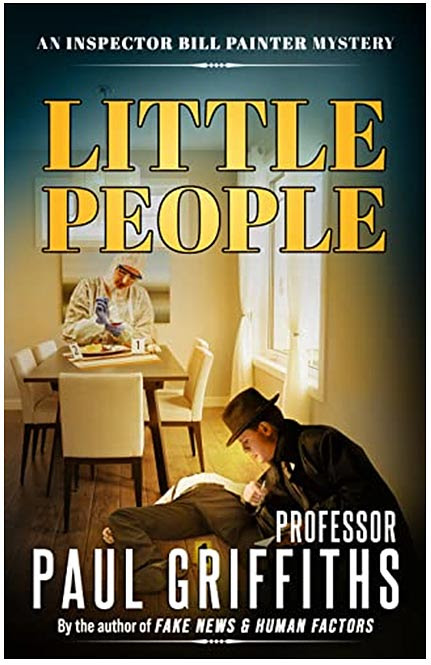
Norm: Good day Paul and thanks for taking part in our interview.
How did your background in
virology and medicine influence your decision to incorporate the
Covid-19 pandemic as a backdrop to Little People:Murder in the
Time of Covid?

Paul: In my professional life, I am based in Pathology (Laboratory Medicine in the USA), with my specific expertise in viruses.
We are presented daily with clinical cases that require investigation to provide a diagnosis that explains all the complex symptoms experienced by the patient.
I have often felt that this parallels detective work to find the cause and perpetrator of a murder; after all, both start with a body.
Norm: As an author with a background in virology, how do you think your expertise enhances the storytelling experience in the crime genre? In what ways does it set your novels apart from others in the genre?
Paul: My novels are different because they are set in medicine and science and are all factually sound. I hope the background introduces readers to the processes we follow when conducting medical research.
Starting with a problem, we create a hypothesis and set out to test it. Once proven false, that hypothesis is discarded and another created and investigated.
Through this iterative
process we arrive finally at an explanation that fits all the facts.
As Sherlock Holmes says: "When you have
eliminated all which is impossible, then whatever remains, however
improbable, must be the truth."
Norm: It is quite intriguing how ricin was used as a poison in the novel. Can you provide more information about your ricin research and its potential use in criminal situations?
Paul: I have not done
any research with ricin. The plot for Little People needed
a poison with particular characteristics and some searching through
toxicology texts identified that ricin fits the bill.
Norm: Inspector Painter is described as an old-school police officer with a love of jazz. How did you develop his character and what inspired you to create a protagonist with such contrasting traits?
Paul: This started with my first novel, Lenti where I created a troubled man whose personality traits led him to commit murder in an unusual way. I needed a detective to chase after him and created Inspector Bill Painter.
Getting him to think
through problems under the influence of jazz was easy because I like
to do the same (although I don't drink whisky). Bill Painter then
became a person we can relate to and is now the common feature in all
my novels.
Norm: In what ways does the Covid-19 pandemic and the socially challenging times depicted in the novel impact the investigation process and the motives of the culprits?
Paul: It is clear that the pandemic predominately affected those in our communities who were already disadvantaged. No political leader in any country made the right decisions at the correct times to minimize the damage to citizens.
Those politicians who locked down their countries early then failed to deploy vaccines quickly enough to allow trade to open up and thus minimize the economic consequences of the prescribed lockdown.
This failure of the
political class, coupled with their inability to admit to mistakes,
has produced some simmering anger among susceptible citizens,
although hopefully not enough to make them turn to murder.
Norm: The description mentions that Inspector Painter's job is on the line when the fourth case appears. Could you delve deeper into the challenges he faces and the pressures he experiences as he tries to solve these independent murders?
Paul: During murder
cases, the press use lurid headlines to help sell newspapers. This
puts political pressure on senior police officers who transmit this
to the investigators at the sharp end. With several linked murders
but no arrests, no suspects or even any connection between the
victims, Painter realizes his superiors will soon replace him if he
fails to make a breakthrough.
Norm: How do you balance merging your scientific and medical expertise with the creation of an intriguing crime scene? Are there any specific techniques or approaches you employ to ensure the authenticity of both aspects?
Paul: All the scientific and medical facts in my books are correct. I aim to present this authentic but complex information to readers that is stripped of the medical jargon and scientific abbreviations that often impede understanding.
To achieve this, I get Professor Hugh McDermott to repeat the simplified explanations he gives to his medical students to Inspector Painter and the team. Applying this information to a crime scene distinguishes between what is possible and impossible, providing leads for Inspector Painter to follow.
Norm: Can you provide some insights into developing the intricate web of intrigue in the novel? How do you create an interesting mystery that keeps readers engaged and guessing until the end?
Paul: I know the readers want to solve the mystery for themselves. As they work their way through the story, they gain additional facts, many of which are confusing.
They are confident that the explanation will be revealed
at the end, but hope to work it all out before the last page. That is
the very nature of a Who Dunnit. All the required facts
are provided, but can the reader sort the wheat from the chaff before
Inspector Painter finally reflects on how the crimes were
committed? \
Norm: The description mentions the lack of connections between the victims and the limited number of people with the opportunity to poison them. Can you discuss the complexities of crafting a plot that incorporates seemingly unrelated murders while maintaining a sense of plausibility and logic?
Paul: I begin with the answer. In this case, 4 individuals who each wish to murder someone. The means to do so is revealed early on when death from ricin poisoning is confirmed.
I give them the opportunities they
need, but many other people in the book also have those
opportunities. Only when the full picture of the 4 deaths is
presented can the underlying reasons and explanations be seen.
Norm: How do you
explore the theme of revenge in Little People? What role does it
play in the motivations of the culprits and the overall narrative?
Paul: The desire for revenge is very strong and is the force that persuaded normally well-behaved citizens to plot to kill selected individuals.
There is a great sense of injustice about the ways members of the working class and their managers had different outcomes from the pandemic. Revenge is not an edifying emotion but it is potent.
Norm: Where can our readers find out more about you and Little People?
Paul: Inspector Bill Painter has his own FaceBook page.
I am honoured to be
included in Who’s Who if anyone is interested in me!.
Norm: What's in store for Paul Griffiths after this interview wraps up?
Paul: I remain Emeritus Professor of Virology at UCL and my interest in viruses is undiminished! I continue to consult and advise on matters of relevance. I am currently working on my sixth novel featuring Inspector Bill Painter which is called Vesicles.
Norm: Thanks once again and good
luck with all of your future endeavors