- Home
- AUTHOR INTERVIEWS- CHECK THEM OUT
- Prepare to be captivated as we welcome the remarkable Thomas J. Madden as our distinguished guest on Bookpleasures.com.
Prepare to be captivated as we welcome the remarkable Thomas J. Madden as our distinguished guest on Bookpleasures.com.
- By Norm Goldman
- Published June 19, 2023
- AUTHOR INTERVIEWS- CHECK THEM OUT

 Norm Goldman
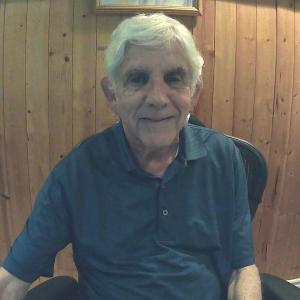
Reviewer & Author Interviewer, Norm Goldman. Norm is the Publisher & Editor of Bookpleasures.com.
He has been reviewing books for the past twenty years after retiring from the legal profession.
To read more about Norm Follow Here
Prepare to be captivated as we welcome the remarkable Thomas J. Madden as our distinguished guest on Bookpleasures.com.
With a passion for journalism and an illustrious career in public relations, Tom's journey is nothing short of awe-inspiring.
Graduating with a Bachelor's degree in journalism from Temple University in 1962, Tom immersed himself in the world of reporting. Starting at The Press of Atlantic City in 1964, he honed his skills as a dedicated and talented journalist.
Soon after, Tom ventured to Philadelphia, where he joined The Philadelphia Inquirer as both a reporter and a captivating feature writer.
Driven by a thirst for knowledge, Madden pursued further education while working the night shift. In 1970, he received his Master's degree from the prestigious Annenberg School of Communications at The University of Pennsylvania. Passionate about sharing his expertise,
Tom taught journalism part-time at Rutgers University before embracing a new adventure in New Orleans. There, he became an assistant professor of journalism at Loyola University.
In 1974, Madden transitioned to the realm of public relations, joining the renowned firm Dudley Anderson Yutzy (now Ogilvy & Mather Public Relations Group) in Manhattan.
Working on prestigious accounts such as Kellogg's, Madden's prowess as a speechwriter shone through. His remarkable speeches for the company's CEO, William LaMothe, graced the pages of The New York Times and Vital Speeches of the Day.
The year 1977 marked a significant milestone as Madden embarked on a new chapter at the American Broadcasting Company (ABC) as the Director of Public Relations Planning. Here, he honed his craft by writing compelling speeches and providing media training to senior executives.
Tom is the author of best-selling books including Spin Man, King Condo, There Enough BRADY in TRUMP to Win in SUPERable Bowl, and Wordshine Man Love Boat 78.
Good day Tom and thanks for taking part in our interview.
Norm: Can you share some highlights from your early career as a reporter at The Press of Atlantic City and The Philadelphia Inquirer? How did these experiences shape your understanding of journalism?
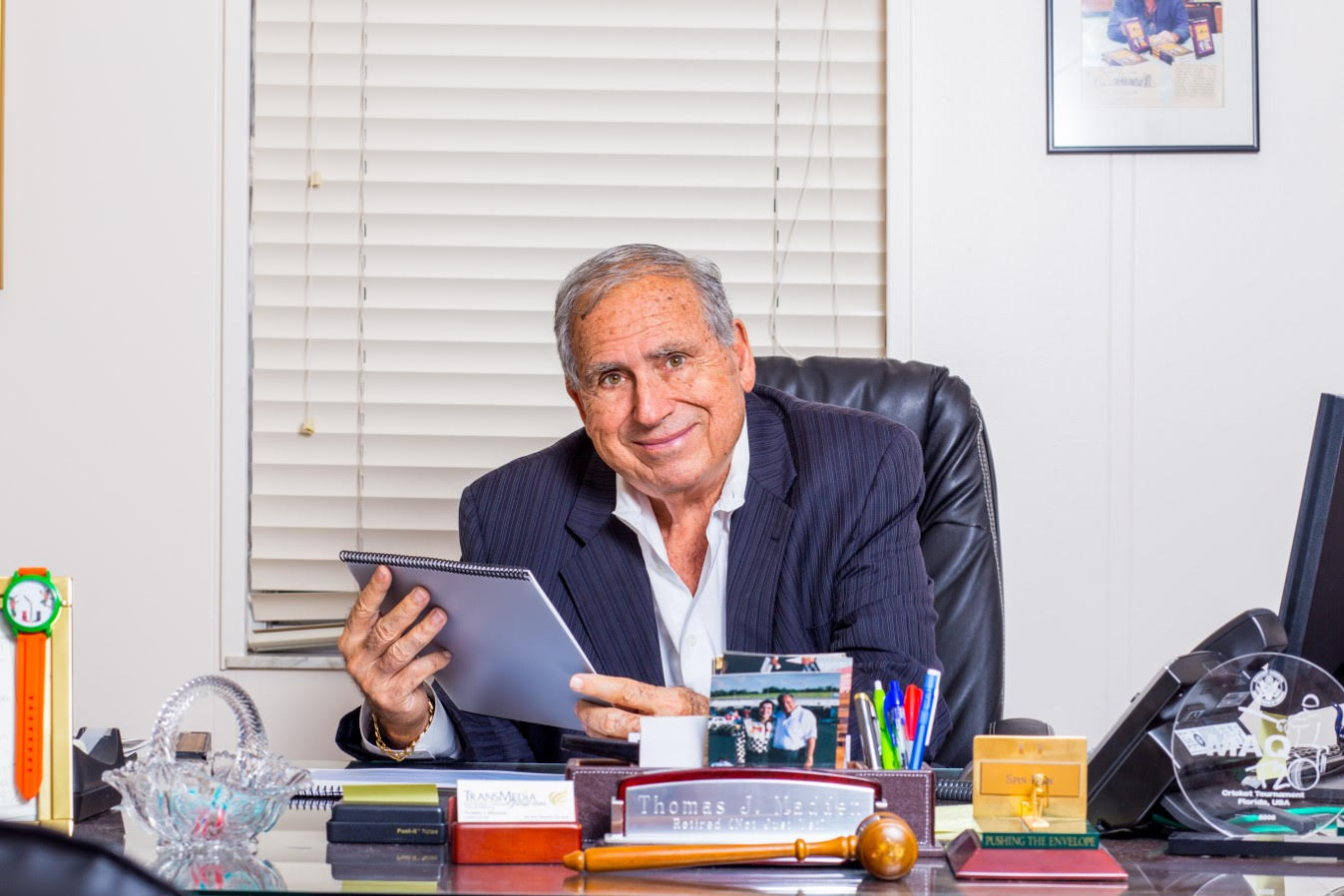
Tom: One of the things I leaned right off the bat as a reporter was to get to the heart of a story without wasting what have become very important in my life—words.
The fewer words the better especially at the beginning when you have to hook that reader’s interest, then you can elaborate more as you go deeper into the story.
I had some exciting experiences as a reporter at The Philadelphia Inquirer that taught me something else you need as a news reporter--chutzpah.
Among them was interviewing airline passengers whose plane was nearly skyjacked and the only way I could get through police lines to interview them was pretending to be waiter bringing them hot coffee while they were being interrogated.
So, when I saw a waiter bringing coffee, I took off my jacket and stuck my notepad under my belt and told the reporter they’re going to need more and I’ll bring this into them now and the coffee got me through the police line and I proceeded to serve the survivors with coffee, while interviewing them, and getting what was so precious, the scoop!
Another was covering President Nixon one night at a concert he was attending at the Academy of Music when shots rang out, and with Abraham Lincoln at Ford Theater in my mind, I made a beeline to Nixon’s booth but was tackled by a secret service agent.
I’m a reporter, I told him. There were shots fired. “That was the 1812 Overture that starts with cannon fire, you jerk,” he told me. So that’s another thing journalism taught me—humility.
Norm; What motivated you to pursue a Master's degree in communications from the Annenberg School of Communications at The University of Pennsylvania? How did this academic background influence your career?
Tom: I thought a master’s degree from such a prestigious school would multiply career opportunities if ever I wanted to do something else besides risking my life as a reporter in a city that at the time was seething with street crime and racial violence. And it worked.
One night I was the only white reporter covering a protest by angry blacks and out of nowhere came a punch to my jaw that knocked off my feet.
The next day minus a couple teeth, I told my wife that I had to go into a new, safer line of work so I accepted an offer to teach journalism at Loyola University in New Orleans. She said okay and off we went to the deep south
Norm: Could you tell me about your time teaching journalism at Rutgers University? What valuable lessons did you learn from this experience?
Tom: My teaching journalism at Rutgers was only part time, but it planted seeds that would later sprout in New Orleans.
At Rutgers I taught several days a week and worked as a city-side reporter on the harrowing night shift.
At the time, the Watergate hearings were happening and I had my class covering those hearings on TV unaware of the irony ahead, my being assigned to cover the star of the Watergate episode, President Nixon, when he was in Philadelphia dodging my imaginary bullets.
Norm; How did you end up at NBC, and what were your responsibilities as Vice President and Assistant to the President? How did your experience in executive administration and programming contribute to your professional journey?
Tom: After three years, I left my teaching position at Loyola as I was missing the excitement of working in a bustling big city and took a job at a major PR firm in Manhattan, Dudley Anderson Yutzy, where I was assigned to work on one of their largest accounts, Kellogg’s Company of Battle Creek, MI.
It didn’t take long for my writing skills to attract the attention of Kellogg’s chairman Bill Lamothe, for whom I wrote speeches, some or which were reprinted in The New York Times.
When the VP of PR at ABC heard about me, he offered me a job as Director of PR Planning and put me in charge of a few other departments at then the number-one TV network.
And that’s when I met the masterful head of programming, the TV wunderkind Fred Silverman, whose speeches I wrote and we became great friends.
And when Fred was offered the position of CEO of NBC, I was the only one he took with him from ABC and I became vice president, assistant to the president and up I went to a nose-bleed executive level at 30 Rock.
Norm: After leaving NBC, you started TransMedia Consultants, Inc., which later became a boutique PR agency. What inspired you to start your own business, and what were some notable projects or clients you worked with during that time?
Tom: I had an exciting time at the two networks, but I thought it would be fun and exciting to start my own PR firm as I had assets, high level media contacts, I was featured on the front page of The Wall Street Journal and my experience was so off the charts I believed I could bring in some big fish as clients. And I was right.
My first client was then the largest company in America, AT&T.
The government was charging they were an oligopoly and was trying to break them up, just as the FTC had charged Kellogg’s and the other giant cereal companies when I was at D-A-Y and I would write how terrible that would be for poor Tony the Tiger and they backed off.
This time it was different for AT&T and they had to shed their operating companies, but I helped another chairman through a most challenging time. Another client I captured was The City of New York for which I developed an award-winning PR campaign promoting fair housing.
Norm; What led you to transition from college teaching to joining the public relations firm Dudley Anderson Yutzy (now Ogilvy & Mather Public Relations Group)? How did your role in this firm contribute to your professional growth?
Tom: I believe I mentioned this earlier as it was indeed a turning point in my career. The chairman of Kellogg’s was so pleased with my work that he would fly into New York on his private plane from Battle Creek just to take me out to eat at the ritzy Plaza Hotel – alas for breakfast. And cereal was always a main course.
Norm:You worked on writing speeches for William LaMothe, the CEO of Kellogg's, which were published in reputable publications. What was that experience like? How did it shape your understanding of effective communication?
Tom: As I said, speeches I wrote for Bill LaMothe were reprinted in The New York Times and Vital Speeches of the Day which played a large role in boosting my reputation, leading to heady offers to work at the TV networks and at that time there were only three and I worked at two of them, holding those nose-bleed level executive positions way high up in the command ranks.
Norm; Joining the American Broadcasting Company (ABC) as the Director of Public Relations Planning must have been an exciting opportunity. Can you share some insights into your role there and the challenges you faced?
Tom: I’ll share this story when I was at NBC, I was asked to fly to London to have lunch with James Clavell, author of the book on which the TV series Shogun was based.
It was a Friday and after lunch Clavell suggested I spend the weekend in Paris, but I told him I had to be back with the cuts of the film interview I did with Clavell in a show I was producing called “The Making of Shogun.” Then he said “no problem.” He told me I could take the Concorde and be back in New York in just a little over three hours.
That sounded, and here’s that word you see running through my life, exciting!
So that’s what I did and when I was back to work, the head of finance called me into his office and gently but firmly criticized me for going over budget by a few thousand dollars.
I told him it would never happen again and unfortunately it never did, but I wouldn’t trade that “double takeoff” experience for anything. First the Concorde took off from the airport in Paris, then it took off again in the air when it left the continental shelf and the centrifugal force threw me back in my seat . . . how EXCITING!
Norm; As an author, you have written several books, including a memoir and a satiric murder mystery novel. Can you share some insights into your writing process and how your personal experiences influenced your storytelling?
Tom: I could go on for hours about my five books, from the SPIN MAN about my topsy-turvy career in PR to WORDSHINE MAN about how to make writing more inviting, but I’ll focus on LOVE BOAT 78.
The latter is about the depression I sank deep into when I lost Angela, my wife for 54 years, to breast cancer.
I nearly went crazy trying everything from bottomless martinis to nearly topless dating service until one day at a neighborhood bar called Duffy’s, I saw a beautiful Brazilian, Rita, and couldn’t resist toasting her and when she toasted back with an unbelievably attractive smile, off to her went prince charming and that was it.
A month later we were married and that was over four years ago and I couldn’t be happier, and happily writing more than ever.
Norm; You have received recognition and awards throughout your career, including the Bronze Anvil Award for a public service campaign promoting fair housing in New York City. How did it feel to be recognized for your work, and how do you believe your campaigns made a difference?
Tom: One of the most inspiring letters I’ve ever received was from “how’m I doin” Ed Koch, who loved the way I put then TV star “Mr T” with a mean face and a clenched fist on advertising that we put into all the subways saying if you’re not fair in housing “you’ll answer to me!”
Norm: As we wrap up this engaging interview, I'd like to conclude with a captivating question. If you had the opportunity to invite three individuals to your dinner table, who would they be and why?
Tom: Donald Trump, Nikki Haley and Peter Ticktin Esq. I’d like to hear Trump and Ticktin, who is a PR client of mine, talk about the time they were both 18 and attending the New York Military Academy together.
Ticktin wrote a book about it called “What Makes
Trump Tick.”
I would love to hear them talk about those times when they were both learning to be leaders in their respective fields, Trump in business and politics, Ticktin in law. And Nikki Haley? I just like her sparkling personality and I think she’d fit in and they’d make a fun and insightful/delightful trio.