
- Home
- AUTHOR INTERVIEWS- CHECK THEM OUT
- Beyond the 1%: The Ultra-Wealthy Elite’s Facade and the Reality of Spousal Abuse in Nunzia Mondo's, My Silent Prison: A Cautionary Tale of Spousal Abuse
Beyond the 1%: The Ultra-Wealthy Elite’s Facade and the Reality of Spousal Abuse in Nunzia Mondo's, My Silent Prison: A Cautionary Tale of Spousal Abuse
- By Norm Goldman
- Published April 14, 2026
- AUTHOR INTERVIEWS- CHECK THEM OUT

 Norm Goldman

Reviewer & Author Interviewer, Norm Goldman. Norm is the Publisher & Editor of Bookpleasures.com.
He has been reviewing books for the past twenty years after retiring from the legal profession.
To read more about Norm Follow Here
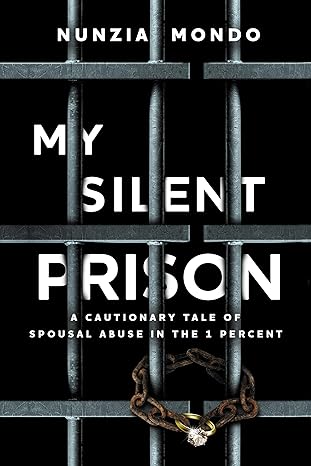
Bookpleasures.com warmly welcomes Nunzia Mondo, author of My Silent Prison: A Cautionary Tale of Spousal Abuse in the 1 Per cent. Her gripping memoir peels back the glittering facade of expat luxury and privilege to reveal thirty years of emotional, physical, and psychological abuse endured in silence.
Nunzia shatters the illusion that wealth offers protection from abuse. She exposes cycles of love-bombing, gas lighting, violence, and control, often rooted in her ex-husband’s borderline traits. With raw honesty, she reflects on her regrets about her children’s pain and her hard-won path to freedom. Today, we’ll explore what sparked her writing, the earliest warning signs, expert insights, and her messages of hope for others.
Hailing from New England, Nunzia launched her career in 1980s finance before crossing the Atlantic for graduate school in London. She married a British classmate who rose to entrepreneurial success, whisking her into a world of international luxury. Yet behind the opulence, she endured relentless abuse for twenty-seven years. It was a final, shattering betrayal that gave her the courage to pursue a divorce she once believed unthinkable. Today, she calls her favorite city home, living with less wealth but an abundance of gratitude for her newfound freedom.
Norm: What ultimately pushed you to break decades of silence and write My Silent Prison, and how did the writing process reshape your understanding of why you stayed so long?
Nunzia: During the divorce process, my GP insisted I go to a psychiatrist because my nerves were frazzled. I couldn’t sleep through the night and had terrible nightmares starring my ex-husband.
The psychiatrist was terrific. She prescribed medications that got me over the hump, coached me through some practical issues I couldn’t figure out on my own, and posed questions that demanded some deep dives.
After 18 months or so, both she and I felt that she could do no more for me. I had to continue healing journey on my own. Inspired by Sigmund Freud, I sat down and wrote for three days, just for myself.
It wasn’t fun, but I was proud of the 20 pages or so that I’d produced over that long weekend. I looked to see if anyone else had written a firsthand account and found only Crazy Love, which involved a loaded gun…
My ex-husband wasn’t as certifiably nuts as the one in that memoir, but the abuse in my marriage took rather different forms that were almost as pernicious. I thought, therefore, that my story could be a useful contribution to the topic now called “intimate partner violence.”
Concurrently, I was reading truly excellent books on abuse by mental health professionals Patricia Evans, Beverly Engel, and Lundy Bancroft.
Now I come to your thorny question about how the writing process reshaped my understanding of why I stayed so long. In fact, the trip down memory lane was harrowing.
As I went through the relationship year by year, I recalled in vivid detail so many anecdotes of deliberate, protracted, relentless cruelty. So much material that I was horrified by the ultimate tally.
At the end of an evening of writing, I felt a physical sensation of revulsion in my esophagus—with my ex-husband and with MYSELF. Writing it all down made me furious—absolutely furious—and I transmogrified from victim to idiot.
I couldn’t come to terms with why I’d been so spineless and stupid for staying—surveying the litany of cruelty gave me zero understanding of why I stayed for so long.
Fortunately, I didn’t have a publishing deadline, so when my life became too busy or the process was too upsetting, I had the luxury of putting the book down and picking it back up again over a 7- to 8-year period.
Time led to more grace for myself. And during this period, there was an explosion of information on the subject of abuse and personality disorders.
The books I mention earlier, the podcasts, and academic studies I reference in My Silent Prison helped me impose a framework on the ton of anecdotes I’d amassed. I saw that a sequential rendering of my story would not be effective; therefore, I parsed it to get rid of less important anecdotes and then organized them into themes.
The wealth of knowledge that emerged during the years of writing allowed helped me impose a cogent framework (or the illusion of one) on my years of hell.
In a nutshell, the writing process was initially painful and never cathartic—as many would assume it was. Forcing myself to face the horror of three decades was the first step in accepting it. I’m not healed, but I am at peace. I also feel that I have something to show for my pain.
I much luckier than previous generations of women who had to stay schtum and completely bewildered and beaten down in their silent prisons.
Norm: Looking back, what early moment with Tom now stands out as the unmistakable first sign of abuse, and what internal barriers kept you from walking away then?
Nunzia: It must be the very first anecdote in My Silent Prison, when Tom knocked me to the floor, blackened my eye, bloodied my nose and lacerated my gums because I had teased him with the intention of cheering him up.
What kept me from walking away was that I’d never seen anything like this before and thought that it was my fault for misreading the situation.
It never occurred to me that this could happen again. Plus, Tom was generous, thoughtful, attentive—so unlike my previous boyfriend of seven years. I adored Tom.
I must admit, though, that there were earlier signs of “control” I hadn’t recognized as such. Telling me that I couldn’t leave the university canteen to go to the library to study.
Demanding to know why I wasn’t cleaning up three days’ worth of his unwashed dishes in his flat before making tea. Expecting that I would pick up the tab for lunch, drinks, textbooks, taxis etc.
Admonishing me for my poor manners in not saying “thank you” frequently enough.
Norm: How did recognizing the love bombing, devaluing, and hoovering cycle—especially in light of Tom’s borderline traits—change the way you interpret the entire arc of your marriage?
Nunzia: After I’d digested it all, I saw that my marriage was a sham. Tom never saw me as a true partner or friend, and he never truly loved me. Really, I was a vessel for his children and the family administrative assistant always on the verge of being fired.
I don’t know if this is true for all folks with Borderline Personality Disorder, but I’m sure that Tom isn’t capable of loving anyone—other than his own mother and three children.
Tom has had two long-term relationships since our split. The first woman, his erstwhile masseuse and escort, was completely unsuitable, could barely carry on a conversation, hated our children (who returned the sentiment), demanded money for her children and endless luxuries and vacations for herself.
She wasn’t a “younger model” or even attractive. In fact, she was the sort of gal Tom would have labelled as “vulgar,” yet he was with her for 4-1/2 years.
He dropped her like a hot potato when the second woman appeared. This woman is, by all accounts, completely different—well-spoken, kind, and, most important, very well-fixed financially.
She was also desperate and lonely when they met, having come out of her own divorce a couple years earlier. Tom succeeded at his charm offensive.
They moved in together almost right away, and I’ve learned that they entered couples counselling almost as soon as they combined households. I’ve also learned that Tom tried to put the same financial moves on her that he did with me when we first met: what’s yours is mine.
She has been able to put her foot down, though.
The point is, it’s never love for Tom; it’s opportunism and emotional neediness. Tom cannot be alone. He didn’t enter our marriage in good faith, a fact that is no doubt lost on him.
Norm: Which incident involving your children haunts you most today, and how has the long-term emotional fallout shaped your relationship with them as adults?
Nunzia: The top spot would have to go to the incident at the airport in France when Tom deliberately rammed his luggage trolley at speed into 10-year-old Dominic.
The most consequential act of abuse directed at Dominic (and me and the other two kids), though, doesn’t appear in my memoir. That was Tom’s prolonged campaign to turn young adult Dominic against me during the divorce by telling him lies about my legal moves.
Tom succeeded big time. Dominic, who’d just graduated from college, became very verbally abusive toward me and went through my files to spy for his father.
At one point during divorce proceedings, encouraged by Tom, Dominic called my lawyer to scream, swear at, and threaten him. As soon as Dominic kicked off, my lawyer pressed record.
My lawyer sent me the audio, and it was horrific. In our jurisdiction, it was enough to get Dominic arrested for criminal intimidation. Because my lawyer felt bad for me, and understood what a bad actor Tom was, he chose not to pursue the matter.
As part of the same campaign to ruin our relationship, Tom then got Dominic to write a letter to the trial judge to report something he thought he’d observed. The judge was furious that the letter had been sent, and, even more so, that Tom’s side wanted it entered into evidence.
When I learned about the letter from my lawyer, I requested to speak to the court. I stood and told the judge that I too wanted the letter read aloud and used as evidence—because it would have meant that 24-year-old Dominic would have to appear as a witness and be cross-examined.
I felt that this was a way to stop Tom’s campaign—and to let Dominic know that actions have consequences and apprise him of the full set of facts so that he could understand that I’d done nothing dishonest or untoward.
The judge said it was inadmissible, so neither Dominic nor Tom had to answer for the generation of this letter.
The passage of years has provided some healing, but Dominic’s and my relationship has never recovered.
The trust isn’t there. Even sadder for me is how badly Tom’s campaign against me—on top of more than two decades of watching his father mistreat his mother—has messed up Dominic in every aspect of his life. I’ve welcomed Dominic back into my life, have forgiven him for his behaviour during the divorce (indeed, I would never mention it), and am now spending a lot of lot of money to get him therapy. I would go so far as to say that Dominic hates me—his siblings think so too.
Norm: Your memoir dismantles the myth that wealth protects women from abuse. How did life in the 1% both shield Tom’s behavior and deepen your sense of entrapment?
Nunzia: It wasn’t so much being in the 1% that shielded Tom or entrapped me. It was more that we were an educated and successful couple, and we came from the upper middle-class of our respective countries—so abuse wasn’t understood or even acknowledged.
I have been told—by people who don’t understand the nature of abuse or my personal circumstances—that there was no excuse for me to stay as long as I did. When you love someone and want to keep your family together, it’s very hard to take those terminal steps.
Furthermore, earlier in the marriage when I’d left temporarily, Tom told me that he would find the nastiest divorce lawyer in town, take the kids and make sure I got nothing.
When I did finally leave for good, I knew Tom would be vituperative. But his financial abuse was even worse than I could have anticipated. I didn’t have access to resources because all assets were in Tom’s name, and he emptied the joint account and canceled my credit cards.
Until the judge forced Tom to give me an interim lump sum and pay me some maintenance, I had to borrow from friends to pay for everything.
People need to realize that financial abuse is often an aspect of overall domestic abuse in marriages of any socioeconomic category. However, rich men have that extra weapon of control.
Not only did I face the openly avowed threat of losing my minor children and personal financial ruin, but I was also frequently told by Tom that I needed to zip my lip with any and all complaints because I lived in such luxury.
(Some abused spouses in wealthy marriages have it even worse: they have $5 in cash in their wallets and the indignity of having to justify every credit card expenditure.)
Ironically, Tom accused me in the final year of not loving him, that I was with him only for “his” money. He must have been projecting onto me the motivations of the various young ladies who were extracting as much as they could from him.
For me, being in the 1% was neither here nor there.
Norm: Which example of gaslighting most eroded your sense of self, and what steps helped you rebuild your confidence and trust in your own perceptions after leaving?
Nunzia: I would say it was the relentlessness of the gaslighting that eroded my sense of self—the sum total of one form of crazymaking or another 365 days a year for thirty years.
Having said that, I’d say that the most difficult example to deal with was the barrage of questions—the same question, screamed at me many times in a row, with no chance for me to answer and always a question that was deflection from the subject at hand.
I feel as though the deflection and irrelevance were deliberate, as was the barrage, but at a certain point, this form of gaslighting served to get Tom himself even angrier, which then inevitably led to unrehearsed but stunning character assassination of me that could last more than two hours.
This extemporaneous ranting was one of Tom’s great skills.
Reading and hearing about the gaslighting experienced by others has gone a long way in rebuilding my confidence. I cannot tell you how many times I read or listened slack-jawed to gaslighting episodes that were exactly like mine.
Of course, writing my whole story down was key in rebuilding my trust in my own perceptions. There were unmistakable patterns, weapons that Tom became so adept at brandishing—gaslighting tricks, it turned out, other abusers used as well.
Norm: You describe Tom’s dangerous driving as a form of abuse. Is there a particular near miss that still triggers flashbacks, and how do you interpret your children’s refusal to drive today?
Nunzia: Norm, thank you so much for this question about driving. It rarely comes up on lists of abusive behavior, and it’s only very recent that folks are discussing reckless driving as a “red flag.” I truly hope My Silent Prison brings driving as a form of abuse to the fore.
The one incident that is the most vivid and triggers flashbacks from time to time is the one that nearly did end in death. It appears in my memoir and took place in the final months of our marriage.
Tom had to metaphorically kiss and make up with some friends he’d insulted (an act of contrition that would have really pissed him off). As we headed home from what was ostensibly a pleasant evening, I mentioned that I’d wanted to speak to the friends about something but had missed the chance.
This sent Tom over the edge. He went berserk, saying it wasn’t his fault. I told him I wasn’t accusing him of anything and said I was sorry that I gave him that impression.
I couldn’t calm him down. He began speeding up the road (I saw the speedometer reach 170 kph), veering in and out of the oncoming lane of traffic.
Once we got off the main drag, he drove almost as fast up a curvy road. It was 15 minutes of sheer terror, and I honestly thought this was the end for us as we reached our place.
As we careened down the drive to our compound, we came very close to flying over the ridge and rolling down the slope to our deaths. Somehow, with one hand on the steering wheel, Tom managed to keep the car on the drive and used his other hand to smash me in the face.
When we parked, we saw that blood was pouring from my nose and mouth. (Of course, Tom was sorry he did that but then found a way—as ever—of blaming me for him getting angry.)
I interpret my children’s refusal to drive as more than the Millennial/Gen X trend of not bothering to get drivers’ licenses. They are all three afraid to drive.
In a rare moment of candor, Dominic told me that the driving instructor used by the boarding school in England refused to take him to the driving exam because he was a peril on the road.
Dominic admitted that he had the same reckless tendencies as his father, but not the same hand-eye coordination. He’d decided not to further pursue a license because he was sure he would kill someone with his car. That would ruin a lot of lives.
Norm: How did Tom’s infidelities, porn spiral, and contradictory “Christian years” converge to create the final three years you describe as ‘hell on earth’?
Nunzia: It’s important to understand infidelities and porn predated and postdated Tom’s Christian Years. The resumption of the infidelity and porn after the Christian Years blossomed into other vices.
It’s not completely clear to me why Tom abandoned his Christianity and his male Christian friends, but I think all it took was an invitation from one of his not very salubrious industry mates, who showed him a very good time one evening. (I mention in My Silent Prison that BPD folks often ape the behavior of those around them.)
He fell into a bad crowd of rich men and finance types, and he was susceptible to the various entertainments they offered—girls, more alcohol than he was used to, and party drugs.
In retrospect, I’m sure Tom was a sex addict who returned to his old activities with great gusto. It is also the case that when you go down one bad path, it’s easy to keep exploring.
Before you know it, you’re imprisoned by your vices. As masses of cultural evidence now indicate, this sense of unbridled entitlement is a big problem with successful, wealthy men.
They’re Big Swinging Dicks who feel as though they should get what they want whenever they want it.
As I lay out in the book, Tom was Big Swinging Dick with a midlife crisis and Borderline Personality Disorder to boot—and that unfortunate alignment of stars spelled pandemonium for everyone in his life.
Norm: Among the experts you cite—Dr. Ramani, Lundy Bancroft, and others—which resource most powerfully validated your experience, and what single piece of guidance would you offer victims still trapped?
Nunzia: I would say that Dr. Ramani most powerfully validated my experience. When she said the cycle of abuse is eternal—that you can count on it—that’s when the penny truly dropped. I’d already left Tom and had listened to plenty of Dr. Ramani, but this pearl of wisdom really stuck with me. She was telling me: Tom’s cruelty would never have abated. It had been a good decision to be done with him.
The single piece of guidance I have for abused partners is this: you’re not going to be able to fix it, so make plans to leave as quickly and safely as possible—and do not go back.
I also found the recounting of others’ real stories by Dr. Ramani and Christina of Common Ego very validating. Gosh, that same thing happened to me! While the scars of abuse are never fully healed, you get some comfort from finding out that you’re in good company.
Hey, maybe I’m not so defective.
The most important concept I learned from was Patricia Evans’s paradigm of Reality I and Reality II, the former being Power Over and the latter being Personal Power. The unwillingness to recognize another’s Personal Power in a relationship is just a microcosm of what we are seeing in society as a whole. Personal Power means respect and mutuality.
Power Over in the form of misogyny, misandry, human trafficking, organized exploitation of minors, Christian Nationalism, antisemitism, Islamophobia, racism, classism, authoritarianism, Trumpian kleptocracy, Antifa, frivolous lawsuits, malicious social media posts—all these phenomena spring from a lack of love, decency, and respect for others.
Think about it: We’re in an endless loop of Reality I/Power Over, both individually and collectively. Our ugliness is autocatalytic and widespread. We see it in friendships, romantic partnerships, in families, at churches, at the little league game, at the office, in our local and national politics, in our foreign policy. I highly recommend Patricia Evans’s book The Verbally Abusive Relationship as a starting point for anyone attempting to effect change at any level.
Norm: As we conclude our interview, do you envision a sequel exploring your healing journey or your children’s perspectives? What core message do you hope readers carry away about love, logic, and leaving?
Nunzia: No, I do not envision a sequel to my own story, and I would not be the right person to explore my children’s perspectives. I hope that Dr. Ramani, who has a huge platform, will write a book on the trauma caused to children who grow up in DV environments.
The trauma is, in many cases, permanent, affecting the ability of these innocent bystanders to conduct healthy relationships as adults. (Dr. Ramani does have, by the way, a lot of stuff on YouTube about this subject.) As a society, we need to prioritize the damage done to children if we want the cycle to end.
My next project is a compendium of stories about abused partners who managed to leave. I want the abused and those who truly love them to know that they should—and can—leave.
To end my part of this interview, Norm, I hope folks understand that My Silent Prison is the result of blood, sweat, and tears. It’s not just my story.
It’s happened to many others, but it doesn’t need to continue. I believe my story stands on its own; it needs no sequel from me. It needs only dissemination and the voices of other victims added to it.
Norm: Thanks once again and good luck with all of your future endeavors.