
- Home
- GENERAL FICTION REVIEWS
- Inside Fran Hawthorne’s Novel, "Her Daughter," Memory’s Fallibility and the Path to Reconciliation
Inside Fran Hawthorne’s Novel, "Her Daughter," Memory’s Fallibility and the Path to Reconciliation
- By Norm Goldman
- Published January 21, 2026
- GENERAL FICTION REVIEWS

 Norm Goldman

Reviewer & Author Interviewer, Norm Goldman. Norm is the Publisher & Editor of Bookpleasures.com.
He has been reviewing books for the past twenty years after retiring from the legal profession.
To read more about Norm Follow Here
Bookpleasures.com is excited to welcome award-winning author Fran Hawthorne to discuss her poignant and page-turning new novel, Her Daughter.
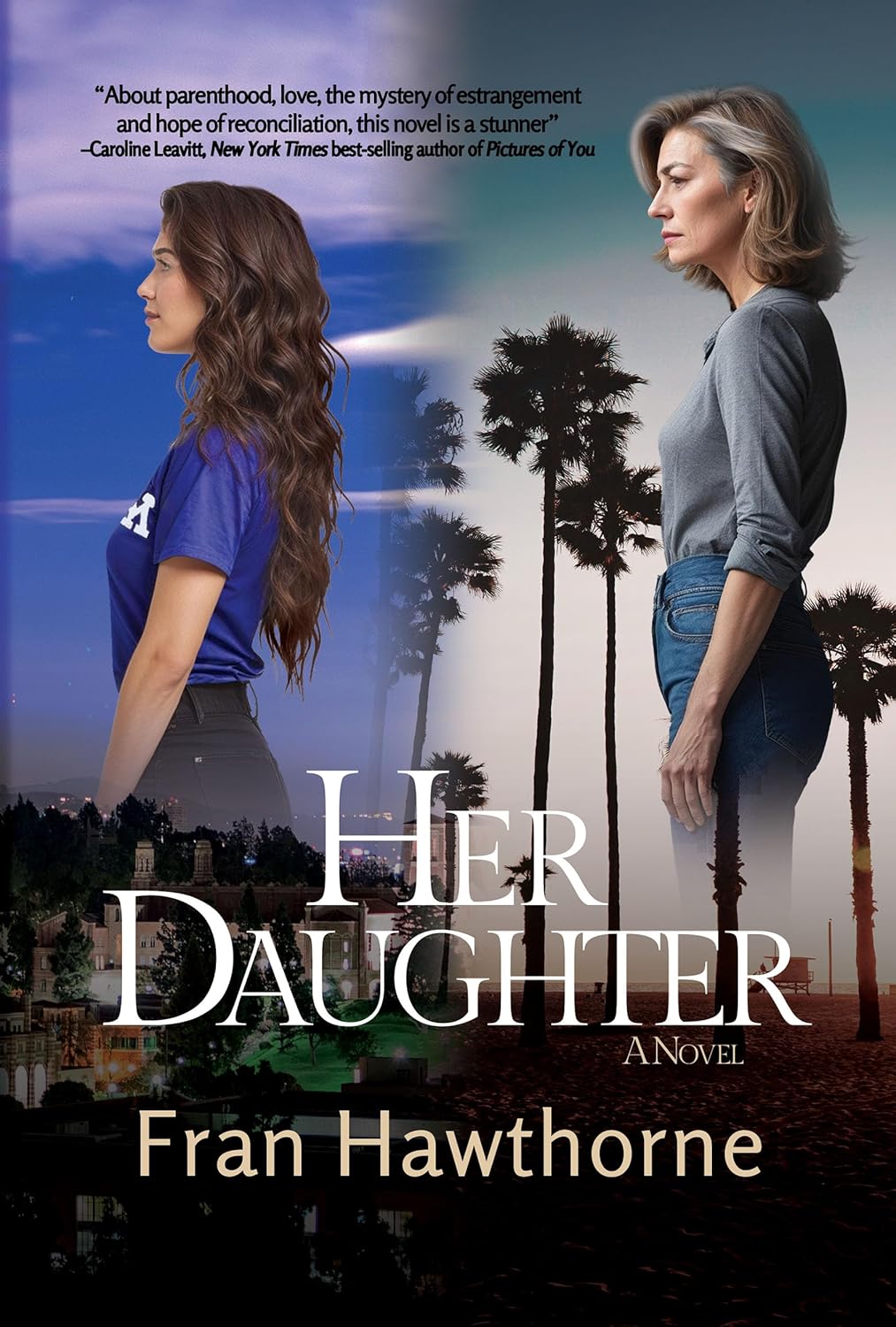
What if the person you loved most in the world, your own child, was systematically turned against you? And what if, after years of agonizing silence, your only news of her came in the form of a cryptic message about her arrest?
This is the devastating reality for Alice Wilson, the protagonist of Fran's unforgettable novel.
Propelled by a mother's fierce love and haunted by self-doubt, Alice embarks on a desperate search—not just for her daughter, but for the truth of why their bond was so cruelly broken.
A masterful exploration of parental alienation, the fallibility of memory, and the resilient hope for healing, Her Daughter is a deeply empathetic and gripping family drama that will resonate with anyone who has ever felt the sting of family fracture.
Today, Fran joins us to discuss the real-world inspirations behind this powerful novel, the intricate process of crafting such a complex emotional narrative, and the difficult, but ultimately hopeful, path toward reconciliation.
Norm: Good day, Fran, and thanks for taking part in our interview.
Fran: Thanks so much for inviting me--and for reading my book.
Norm: You have a distinguished career in nonfiction and journalism. How does that background in reporting facts and investigating truths inform your fiction writing, especially in a story that is part mystery? What does the novel form allow you to explore about human nature and society that nonfiction cannot?

Fran: Norm, thank you for that lovely adjective "distinguished."
What I've learned is that fiction and nonfiction have different kinds of truths. My nonfiction experience trained me in the fact-checking kind of truth--maybe too thoroughly.
For instance, I ran all around New York City, where I live, trying to find an IHOP restaurant so I could get the colors of the booth right, in an important scene between Alice and her daughter. (Brown and blue, if you want to know.)
On the other hand, fiction gives me the freedom to imagine and feel the inner truth of a situation like Alice's panic when she learns that her daughter has been arrested and she has no idea where the girl is or what the charges might be.
In traditional journalism, you can deduce hidden facts from evidence to some degree, as a detective does--but no imagining is allowed!
Norm: In your dedication to Her Daughter, you state, "For every Alice and Esme," and the promotional materials note you've known people with similar experiences.
What was it about the theme of parental alienation that compelled you to build a novel around it?
How did bearing witness to those real-world stories influence your responsibility in portraying the emotional truth of this kind of trauma for both the parent and the child?
Fran: The good news is that the public has become more aware of the seriousness of domestic abuse. But the problem is that too many outsiders assume that "abuse" must be physical.
Friends and families of some of the people I've met would tell them patronizing things like, "It's only words" and "Big deal, divorced parents always argue about their kids."
So I do feel a responsibility to portray the trauma as powerfully as I can--to let the victims know that their stories matter, that words and manipulation and gaslighting are real forms of abuse; and also to ask outsiders to pay attention.
And there's another way this book might bear witness. I think that it's almost an inherent part of being a parent to have a fear of losing your child in some way--a fear that's so horrible that we almost never let ourselves think about it.
Norm: The story opens with a shocking arrest, but the "burglary" turns out to be something much more personal and less malicious.
Was it your intention to use this event to subvert the reader's expectations and reveal character rather than drive a crime plot?
How does this revelation about the earrings reframe our understanding of Esme and her motivations?
Fran: Exactly. I never intended to write a "crime novel." By opening with the news of Esme's arrest, I wanted to reveal two key aspects of Alice: how completely cut off she has been from her daughter, plus of course her worry and terror, as a mother, about what her daughter might be going through. She starts with a set of pat assumptions about Esme's motivation--drugs, a boyfriend who's a drug dealer-- because she doesn't have enough information about her own daughter to even establish an educated guess.
The more she uncovers about the burglary itself, the more she learns about Esme.
Norm: How did you approach writing a character like Dan to make his cruelty feel so chillingly realistic without turning him into a one-dimensional villain?
In the end, we learn that Dan has been cut off by Esme as well. Was it essential for you to show that his need for control ultimately cost him everything, making him a more tragic, if still unsympathetic, figure?
Fran: Creating Dan's character was one of the hardest parts of writing this book. When my friends read early drafts, they told me that he was too much of a villain, so I kept going back, weaving in more and more "redeeming virtues" and sympathetic backstory.
Of course, once I started doing that, the sympathetic strands multiplied of their own accord! I didn't "decide" to have his mother own an antiques business or wall off her children from half of their house; that image just appeared.
Then, in the final scene with Dan and Alice, I faced a crucial choice: One editor urged me to show Alice taking steps to reconcile with Dan. The editor said readers would want that. But it felt too fake to me.
Instead, I tried a version where Dan remains as nasty as he always was, and that, too, was unsatisfactory, because he needed to grow and change, just as Alice, Esme, and the others did. I guess I kept toggling until I hit on an ending--a few lines of dialogue, a movement--that seemed right.
Norm: Alice spends much of the novel questioning her own past actions—wondering if she was a bad mother.
Can you talk about the challenge of writing a character consumed by this level of self-doubt while also driving the story forward with such fierce determination?
Did you see her investigation into Esme's arrest as also being an investigation into her own identity as a mother?
Fran: That's a good question, because too much introspection can really drag down a narrative. I tried to have Alice's self-doubt tie directly into developments in the plot. For example, when she learns that Esme had bulimia--which is an important step toward finding Esme --Alice immediately blames herself, asking: What clues had she missed? And thus, yes, in trying to understand who Esme is, Alice will inevitably come to understand more about herself as Esme's mother. I think those two searches go hand in hand.
Norm: For much of the book, Esme is an enigma we only see through Alice's memories, old photos, or the accounts of others. How did you approach building a fully developed, complex character who is primarily off-screen?
The revelation of Esme's bulimia is a heartbreaking secret Alice never knew. Why was it essential to give Esme this hidden struggle, separate from the central conflict with her mother?
Fran: Since the entire novel is written through Alice's close-third person point of view, and Esme isn't in her life in the present-day chapters, I had to find other, perhaps second-hand ways to portray Esme's personality.
I actually loved that challenge! Maybe this brought out my old journalism instinct for assembling clues-- tidbits like Courtney's memories from Esme's brief visit to her bakery, or Esme's self-analysis letter to the sorority housemother.
I confess that I hesitated to burden poor Esme with bulimia, on top of everything else. Also, I worried that an eating disorder might seem like a cliche, because it's become almost shorthand for describing a young woman who feels she has no control over her life.
But it just seemed like something Esme would do, in her own effort to exert control--a natural extension of her earlier food issues. Remember how she would eat only food that was orange, when she was little?
And then her teenage focus on organic food? Also, it was important to show that not all the stresses in her life are directly connected with her mother.
Norm: The novel's dual timeline, flashing between the present-day search and the past, is incredibly effective at building both empathy and suspense. Did you always envision telling the story this way?
What did this structure allow you to do that a linear narrative wouldn't have? For instance, in creating dramatic irony for the reader who sees Dan's manipulations long before Alice understands their full impact?
Fran: In fact, the earliest drafts of the novel had four timelines! (That was ridiculously complicated, I might add.) One reason is just what you suggest--so that the reader would see "Dan's manipulations long before Alice understands their full impact."
In addition, I liked the way the dual timelines enable the book to start right out with two big mysteries, not merely one: How did Alice get so alienated from her daughter, and why did Esme get arrested?
Norm: The ending is deeply moving but also very realistic; it's not a perfect reunion, but a fragile beginning. How did you decide on the right emotional note to end the story on?
Was it ever tempting to write a more complete, "Hollywood-style" reconciliation, or did you feel it was essential to honor the deep damage that had been done by ending on a note of tentative hope?
Fran: I was never tempted to write a Hollywood ending, because it would be too unbelievable. Originally, the book had a more depressing ending, but that was too strong. I wanted to give the reader some hope, yet without cheating.
Norm: Despite the novel's heartbreaking subject matter, it is ultimately a story of hope. Where does that hope come from in the story? Is it found in the possibility of reconciliation, or in Alice's own journey of self-discovery and perseverance?
What do you think the final gift of the fir-tree earrings signifies for the future of Alice and Esme's relationship?
Fran: I think the hope comes from both Alice's and Esme's self-discoveries, with a little help from their friends, who go through their own journeys of change and awareness.
The earrings say what Esme is still too conflicted to say in words: "I remember happy times together, and I don't want to be cut off from you completely, but I need to do this in my own way." So, yes, there is a possibility of reconciliation. I'd love for readers to imagine how that reconciliation might come about--or get waylaid.
Norm: The novel suggests that memory is not fixed, but a story we tell ourselves. What draws you to this theme of memory and its fallibility?
In a family conflict this deep, do you believe there is an "objective truth" to be found, or is it always a matter of conflicting, deeply felt perceptions?
Fran: Even in a less conflicted family, I think memories can differ dramatically. Here's a small example from my own life: My son insists that when we were at the playground years ago, he was nipped by a squirrel.
I absolutely cannot remember anything like that. We tease each other about it now, and it's hardly a "deep conflict," yet obviously our memories can't both be true. (For that matter, we could both be wrong.)
As human beings, we all sometimes see the same incidents slightly differently, and over time our memories keep changing. Eventually, we may agree to a compromise version of an incident, and that version becomes a fixed "memory."
Why am I drawn to this theme of memory and fallibility? In part, I think it's because memory is the beginning of storytelling; a memory is a piece of an event that once happened. And the discord of different memories is simply another way of defining points of view.
Norm: Alice's friends, Roz and James, offer different forms of support, yet they have their own blind spots and secrets. How do they function as foils to Alice and help illuminate her journey?
Esme's boyfriend, Bobby, is another character who defies expectations. Why was he the right person to ultimately act as the bridge between mother and daughter?
Fran: First, I wanted to show the richness of the worlds that Alice and Esme inhabit, including some of the people in their worlds, to flesh out their personalities. Roz offers Alice uncomplicated support, but her rose-colored optimism can be grating.
James offers practical help but a more complicated friendship. They both try to nudge Alice in an emotional direction she doesn't want to go in. As for Bobby: As Alice gets to know more about him and see how loyal he is to Esme, she is forced to rethink her assumptions.
Ultimately, only he could bridge the gulf between Alice and Esme because he's the only one they can both trust. He loves Esme and respects her pain and her memories. Yet he also wants her to reconcile with Alice, because he understands the pain of not having a mother.
Norm: While Dan is the primary antagonist, Alice is not portrayed as a perfect saint; she reflects on her own shortcomings. How important was it for you to explore the nuances of blame in a family breakdown?
Do you think that by acknowledging her own flaws, Alice is better able to find a path toward a potential reconciliation with Esme?
Fran: A family breakdown--a breakdown in any relationship--has many causes and "villains." I suppose that's what makes a story and its characters more interesting--and believable.
Similarly, in order to mend a strained relationship, both parties have to acknowledge their own faults. It's pretty hard to reconcile with someone who accepts no responsibility and puts all the blame on you!
So I would say that exploring the shared blame in all its nuances was the necessary foundation for writing this book.
And let's not put all the blame on Alice! Esme also needs to acknowledge her own flaws and be willing to hear Alice's acknowledgment. Reconciliation is a complicated dance.
Norm: Where can our readers find out more about you and Her Daughter?
Fran: Thank you for asking. Probably the best place is my WEBSITE
(That site has links to my social media on Instagram, Bluesky, Goodreads, and LinkedIn, and also links to places where people can order my book, such as bn.com, Amazon, and Bookshop.org)
Norm: As we end our interview, what do you hope readers who have been touched by family estrangement—whether as a parent, a child, or a witness—take away from Alice and Esme's story?
Is there also a message in the book for the friends and communities that surround those who are estranged, like the characters of Roz and James?
Fran: The most important message for the victimized parent and the children is: "You're not weird. You're not alone. And it's not your fault."
And I hope friends, witnesses, and the community will understand that this is a form of deliberate psychological abuse, not just "an ordinary he said/she said divorce spat."
Norm: Thanks once again and good luck with all of your future endeavors.