
- Home
- Biographies & Memoirs
- Twice Blessed” by Stefanie Mercado Altman, Claire Altman & Stan Altman: Three Voices in One Unforgettable Family Memoir
Twice Blessed” by Stefanie Mercado Altman, Claire Altman & Stan Altman: Three Voices in One Unforgettable Family Memoir
- By Norm Goldman
- Published October 21, 2025
- Biographies & Memoirs

 Norm Goldman

Reviewer & Author Interviewer, Norm Goldman. Norm is the Publisher & Editor of Bookpleasures.com.
He has been reviewing books for the past twenty years after retiring from the legal profession.
To read more about Norm Follow Here
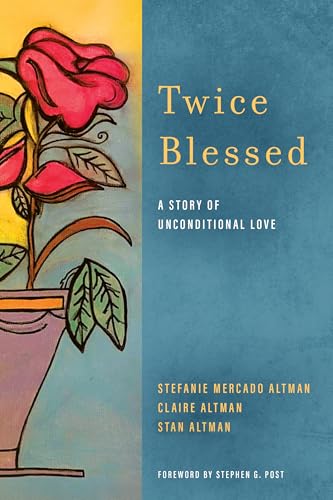
Authors: Stefanie Mercado Altman, Claire Altman and Stan Altma
Publisher: Empire State Editions, an imprint of Fordham University Press
ISBN: 9781531511807
In an era when the definition of family continues to evolve, Twice Blessed offers a profoundly moving testament to how love transcends traditional boundaries.
This remarkable memoir, told through three distinct voices, chronicles an extraordinary adoption journey that began amid the AIDS crisis of the 1990s and culminated in the creation of an unconventional yet deeply loving family.
The book’s narrative structure is its greatest strength. Each chapter rotates between perspectives: Stefanie Mercado Altman, the daughter; Claire Altman, her adoptive mother; and Stan Altman, her adoptive father.
This tripartite approach creates a rich, multidimensional story that allows readers to experience pivotal moments from multiple viewpoints, understanding not just what happened, but how each family member processed these life-changing events.
The story begins in 1991 when Claire and Stan Altman opened the Highbridge-Woodycrest Center, one of New York City’s first residences for families affected by HIV/AIDS. Rosa Mercado and her three-month-old daughter Stefanie became the center’s inaugural residents.
What developed between Rosa and Claire was more than a professional relationship—it was a profound sisterhood.
As Rosa’s health deteriorated, she made a crucial decision: she asked Claire and Stan to become Stefanie’s guardians, ensuring her daughter would have loving parents who would honor her Puerto Rican heritage while providing opportunities Rosa herself never had.
Rosa’s death in 1996, when Stefanie was only five, marks the beginning of a six-year odyssey through a broken system. The Altmans found themselves in a precarious shared custody arrangement with Angela, Rosa’s former partner, and Rosa’s brother.
What follows is a harrowing account of navigating family court bureaucracy, enduring constant hostility from Angela and the uncle, and fighting to protect Stefanie from an increasingly unstable living situation—all while maintaining their promise to Rosa.
Stefanie’s voice is particularly compelling. Her childhood memories—from the magical first trip to the Museum of Natural History where she expected to see living dinosaurs, to the traumatic night in November 2001 when police raided Angela’s apartment—are rendered with remarkable clarity and emotional honesty.
We witness her transformation from a withdrawn, frightened child hiding behind furniture to a confident young woman who discovers her passions: horses, theater, music, and eventually public health advocacy.
Stan and Claire’s perspectives reveal the emotional toll of raising a child under constant threat.
Their accounts of weekly drop-offs at Angela’s apartment, contentious phone calls, and the exhausting process of documenting every incident for potential court proceedings paint a vivid picture of parents caught between their love for Stefanie and the legal system’s failure to prioritize her well-being.
The authors don’t shy away from showing their own vulnerabilities—Claire’s fear of not being a good mother given her own distant relationship with her mother, Stan’s struggle to overcome childhood trauma that made him wary of opening his heart again.
The book excels at interweaving personal narrative with historical context. The AIDS crisis serves as more than backdrop; it’s the crucible that forged this family.
The authors’ response to 9/11—transforming their wellness center into a support hub for first responders—demonstrates their commitment to service even amid personal turmoil. These moments remind us that individual stories unfold against larger historical forces.
At its heart, Twice Blessed is about chosen family and the radical act of unconditional love. Stan and Claire were in their fifties when they became parents to Stefanie, crossing generational, racial, and cultural divides.
The book honestly addresses these differences—Stefanie’s struggle to connect with her Puerto Rican heritage, the challenge of white parents raising a Latina daughter, the skepticism they faced from social workers and family members alike.
The epilogue satisfyingly follows Stefanie through her education at Ithaca College and London School of Hygiene and Tropical Medicine, to her career in public health—a full-circle moment that honors both Rosa’s dreams and the Altmans’ dedication.
The inclusion of photographs, a chronology of custody events, and even Rosa’s artwork adds texture to this deeply personal narrative.
If there’s a weakness, it’s that the extensive detail—particularly during the eight-month family court trial—occasionally slows the narrative momentum. However, this thoroughness serves a purpose: it exposes the Byzantine nature of family court and advocates for reform in how guardianship and adoption cases are handled.
Twice Blessed will resonate with adoptive families, especially those navigating non-traditional arrangements, but its appeal extends far beyond that audience.
Anyone who has loved fiercely, fought against unjust systems, or questioned what makes a “real” family will find themselves reflected in these pages.
The book is ultimately a love story—not just between Claire and Stan, whose partnership provides the foundation for everything else, but between all three authors who chose each other and built something beautiful from tragedy.
As Stephen G. Post notes in his foreword, this is a book about “the kindness of strangers” evolving into the deepest familial bonds.
It’s a reminder that family is not merely who we’re born to, but who shows up, who stays, and who loves us through the darkest moments.
Twice Blessed earns its title: Stefanie was blessed twice—first by Rosa’s love and foresight, and again by Claire and Stan’s unwavering devotion. Readers, in turn, are blessed by this beautifully rendered story of how three lives became one family.
Connect with me on: LinkedIn, Facebook, Twitter/X, Instagram