
- Home
- AUTHOR INTERVIEW SERVICE
- Sue William Silverman’s Latest Insights: "Selected Misdemeanors: Essays at the Mercy of the Reader"
Sue William Silverman’s Latest Insights: "Selected Misdemeanors: Essays at the Mercy of the Reader"
- By Norm Goldman
- Published August 26, 2025
- AUTHOR INTERVIEW SERVICE

 Norm Goldman

Reviewer & Author Interviewer, Norm Goldman. Norm is the Publisher & Editor of Bookpleasures.com.
He has been reviewing books for the past twenty years after retiring from the legal profession.
To read more about Norm Follow Here
Bookpleasures.com is honored to have Sue William Silverman as our guest, an award-winning author celebrated for her honest and powerful stories about trauma, identity, and healing.
With a remarkable literary journey, Sue has penned eight books, a mix of memoirs, poetry collections, and essays, all of which are a testament to her unique blend of lyricism and unflinching honesty.
Her debut memoir, Because I Remember Terror, Father, I Remember You, not only won the prestigious Association of Writers and Writing Programs Award in creative nonfiction but also left an indelible mark on the literary landscape.
Her memoir Love Sick: One Woman's Journey through Sexual Addiction, a powerful narrative, was not only adapted into a Lifetime TV movie but also received two PRISM Award nominations, a testament to its impact.
Another notable work, The Pat Boone Fan Club: My Life as a White Anglo-Saxon Jew, was a finalist for Foreword Reviews' IndieFab Book of the Year Award.
Sue is also a respected teacher and speaker, serving as faculty co-chair of the MFA in Writing Program at Vermont College of Fine Arts.
She has appeared on popular national TV programs, including The View, Anderson Cooper 360, and PBS Books.
Her newest book, Selected Misdemeanors: Essays at the Mercy of the Reader (University of Nebraska Press, 2025), continues her signature style of honesty and lyricism through a collection of flash essays.
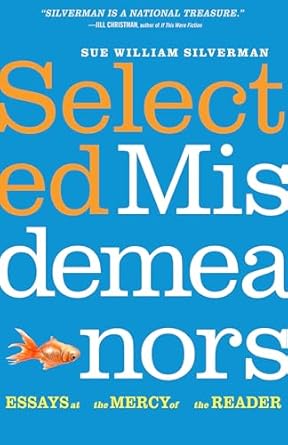
In this interview, we'll explore this compelling work and hear more about Sue's creative process and insights.
Norm: Good day, Sue. Thank you for taking part in our interview.
How do you see the interplay between the 'minor' and 'profound' moments in your essays? Could you share a moment when a minor 'misdemeanor' revealed a deeper meaning for you?
Can you share a moment when a minor "misdemeanor" revealed a deeper meaning for you?

Sue: Hi, Norm. Good question. Of course, all “misdemeanors” are not created equal.
Here is an example: One of my overall misdemeanors was my attraction to emotionally dangerous men.
But it started “small.” In high school, for example, I had a serious crush on Jamie, who was, seemingly, a sweet, innocent young man.
However, after writing about him, I realized he actually didn’t treat me well in that he broke up with me, returned to me, then broke up with me again—several times.
During the writing process, I came to realize he wasn’t quite the sweet guy I idolized in high school. Additionally, while writing these essays, I realized he was the first in a series of more and more dangerous men.
In short, by the time I was a freshman in college, I had affairs with married men, men old enough to be my father.
During the writing process, I came to understand that my own unfortunate decisions around men began earlier than I realized, and that the degree of danger, over time, escalated.
Norm: Your work blends memoir and essay form in a fragmented, non-linear structure. How do you decide which memories or moments to include and how to arrange them?
How do you think the non-linear structure shapes the reader's experience?
Sue: The non-linear structure makes for a more interesting book. To write chronologically can be (not always, but can be) kind of boring.
It’s too easy to fall into a pattern of writing along the lines of “this happened, then this happened, then this next thing happened.”
In other words, one event follows the next, but there’s no thematic connection among the events. No cause-and-effect. Each moment is disparate.
A non-linear structure, however, provides the opportunity to write thematically. Each essay, in some way, speaks to and enhances the theme—deepens the theme.
Therefore, the book conveys a sense of an emotional journey; there’s a connection among the essays: because X happens, Y now happens.
This also helps me understand which essays belong in the book, which don’t. If an essay doesn’t speak to the theme, it’s kicked out (or saved for another book). If, however, the essay deepens the theme, it’s included.
Norm: The collection opens with "Strange Entanglements," exploring childhood and family dynamics. How did revisiting these formative experiences shape your understanding of your identity as you wrote? Did any childhood memory feel different or surprising as you wrote it down?
Sue: Just to be upfront, my father sexually misloved me while I was growing up. But no one talked about it. I never told anyone. I thought this idea of silence pertained only to my home, to me.
Then, when I wrote the essay in this book, “The Silence Detector,” I had an epiphany. This essay revolves around the first time I visited a high school friend, at her home, and I noticed cigarette burns on the arms of her much younger sister.
I don ’t recall if I was about to say anything about the burns or not, but immediately my friend whispered “sssh,” indicating not to speak.
While no one in my family said “sssh,” that was clearly the message I received growing up: Don’t tell anyone what my father was doing to me.
At the time, I only had a vague understanding about the idea of silence in households where children are harmed. By writing the essay I came to understand how pervasive and damaging it is, how it allows the damage to continue.
Because of this prevalent insistence on silence, I never told anyone about my father until I was in my 30s.
Norm: How do you balance poetic, lyrical prose with the rawness required to depict trauma and mental health struggles authentically? How do you choose when to use poetic language versus straightforward honesty?
Sue: Interesting question because I think poetic language—which is to say metaphoric language—is more emotionally honest, not less.
Let me give you an example. One essay, “Psych Ward, Drought,” is about a time in my adult life when my unexamined life was catching up on me—all my emotional misdemeanors.
So, ok, I could have straightforwardly written: “One summer when I lived in Georgia, my husband was out of town, and the air was hot and stifling. It hadn’t rained in weeks.
And, honestly, what with the heat—on top of my husband’s abandonment—I was lost and depressed and thought I was having a nervous breakdown.”
But here is what I actually wrote in the essay: “My fantasies ranged from cloudy skies to soft drops of water to a deluge of biblical proportions. In the dryness—maybe I fantasized it, maybe I didn’t—I heard random things cracking.
Like coffee cups in the pantry. Egg shells in the refrigerator. Needles of loblollies. Legs of daddy longlegs. Strands of my hair. The top of my skull. This was the final motivation I needed to drive to the psych ward at the local hospital on September 1. I’d had it.”
In other words, by describing sensory images outside of me (coffee cups, egg shells, strands of hair), I metaphorically depicted that interior feeling of loss and depression: that I was cracking.
In this way, I am better able to bring the reader inside the experience. A reader can’t relate to abstract words such as “loss” or “depression.”
Those words are generic. But by showing the feeling metaphorically via slanted tangible imagery, the reader can feel or imagine what the narrator is feeling.
Not to say there aren’t times when I write in a straightforward manner. I do. But the times to write metaphorically (i.e. more poetically) are those moments when you want the reader to experience that which you, as narrator, are experiencing.
Norm: Two distinct narrative voices—youthful innocence and reflective wisdom—interact throughout the book.
How did you develop this duality, and what does it allow you to express? Was it challenging to keep your youthful and reflective voices distinct?
Sue: Yes, that is a challenge to weave together those two voices, but doing so is crucial to creative nonfiction. In a craft book I wrote (Acetylene Torch Songs: Writing True Stories to Ignite the Soul), I differentiate these two voices as the “Unaware Voice” and the “Aware Voice.” Both are crucial to a narrative.
The Unaware Voice depicts the events as you observe them at the time that things happened. For example, in the above example from my essay “Psych Ward, Drought,” I did need to let the reader straightforwardly know that 1) it was summer in Georgia, and hot; 2) I was depressed.
Also, earlier in the essay, I tell the reader that my husband is out of town. In short, the Unaware Voice must offer the facts of what happened. But the voice of this narrator is limited; she doesn’t know what the facts mean. She can only tell you the surface story of what happened.
Enter the Aware Voice, who, in effect, is the author adding those metaphorical layers in order to deepen and make sense of the original experience.
It’s the Aware Voice, in the above example, who wrote about feeling as if the cups, the egg shells, the strands of hair were cracking. The job of the Aware Voice is to discover the metaphors of the experience, and these metaphors shine a light on how the narrator is feeling—her interiority.
In sum: the Unaware Voice says “this is what happened.” The Aware Voice says “this is what it means.”
Norm: Everyday objects become powerful symbols in your essays. Could you share examples of some that held particular significance for you and why? Which everyday object in your essays holds the strongest personal meaning?
Sue: To return again to “Psych Ward, Drought,” those everyday objects like coffee cups, eggs shells, strands of hair become not so everyday once they’re transformed metaphorically.
Everyday objects are crucial in creative nonfiction because that’s where we discover our metaphors. All a metaphor is is an everyday object described in such a way (slanted) to cast light on the narrator’s interiority.
On the cover of Selected Misdemeanors is an image of a goldfish, belly up. This goldfish, in the essay “Love Deferment,” is a metaphor (in the context of the essay) not just for physical death, but for betrayal in matters of love as well as the absence of love.
In the essay itself, my unloving boyfriend is off at boot camp; I buy a goldfish for company; I betray my boyfriend by having an affair with his roommate. So one of my misdemeanors is the relationship with the roommate.
Additionally, when the roommate breaks up with me, I’m so distraught I forget to feed the goldfish. Who dies. Another of my misdemeanors. But this goldfish is a metaphor for me because he encapsulates more than just my misdemeanor of forgetting to feed him.
The fish is a metaphor for the loss of love.
Each essay in Selected Misdemeanors revolves around a metaphoric image or sensory detail like that in order to deepen the narrative.
Norm: How do you decide which memories to bring forward in your writing?
Sue: In my first four books of creative nonfiction, I focused on what might be considered “large” memories, experiences, or themes such as (in my first book) growing up in dangerous family and (in my second book Love Sick) recovering from sexual addiction.
My third book, The Pat Boone Fan Club: My Life as a White Anglo-Saxon Jew, explores my very misguided, yet sincere, search for spirituality.
And, in my fourth, How to Survive Death and Other Inconveniences, I focus on my fears surrounding death—defining death rather broadly—by including emotional and spiritual “deaths.”
After exploring these “large” memories, now, in Selected Misdemeanors: Essays at the Mercy of the Reader, I’m able to write about those seemingly “smaller” memories. That’s the beauty of the flash essay.
Here’s how I see the difference between large and small memories—or moments in a life:
It’s an interesting phenomenon, but, when you think of it, many writers (initially, myself) tend to more immediately examine those big life events: marriage, divorce, unhappy childhoods, addiction, etc.
But, over the course of a life, in many instances, these big events don’t take up as much time as all the rest of the time of our lives.
And all the rest of the time is, in fact, a lot of time. We see small moments of beauty, miniature forms of betrayal, snippets of loss.
These brief increments that make up a day, a week, a month are significant. Or can be if we write them. For example, that goldfish I mention above: I could only develop a narrative about a dead goldfish in a flash essay.
Flash, then, is a focus on what we can learn about the self—and its place in the world—by examining small increments of time between the big life events.
Norm: How do you maintain vulnerability while protecting your privacy?
What challenges did you face in writing about complex topics such as obsessive love, addiction, and mental illness? How did you overcome these challenges and maintain your honesty and vulnerability in your writing?
Sue: The main challenge wasn’t so much in the actual writing, but in the ten years that led up to writing creative nonfiction.
In short, I spent ten years cloaking my true narrative in fiction—and I have about five awful (unpublished) novels (hiding in drawers) to show for it. I was scared to write my truth all those years, so, unconsciously, I avoided it.
But once I began my first memoir, I honestly did not face significant emotional challenges. I left those behind me. It was actually a relief to finally tell my truth! Now I controlled the narrative.
Now I had a voice. It’s empowering to set my own true words down on paper. It lightens the load. No longer did I have to use all that energy staying silent.
I had already survived my past. If I was strong enough to have survived it, I was strong enough to write it.
Revealing decades-old secrets is vulnerable, sure. But if you’re going to fully commit to a creative nonfiction memoir or essay, well, you also have to commit to vulnerability.
What did I find? Readers respond to vulnerability. If I write of my pain, it will touch a reader’s pain. If I write of loss, it will touch yours. Because of this relationship that develops between writer and reader, I discovered we’re all empowered together.
Norm: Your essays offer both personal confession and a hand of solidarity to readers facing similar issues. Was fostering this sense of community intentional?
Sue: Initially, no. In my first book, I just had to write, write, write about growing up in this dangerous family. After spending those ten years writing fiction, I wrote my first memoir in about three months—as if in a brain fever. It just fell out of me.
After the book was published, and I began to receive messages from other women with similar experiences, I began to understand this idea of community.
Even now, though, during the writing process, I maintain the focus on the writing: as it should be. First and foremost, after all, I need to get the words down on paper, and revise, revise, revise until I’ve written as best I can.
Only after, do I turn my attention to publication and the outside world. And, with every book, every time, I do realize the importance of this sense of community.
Norm: Where can our readers find out more about you and Selected Misdemeanors?
Sue: Of course you can visit my PERSONAL WEBSITE Also, my books are available wherever books are sold, but here are some direct links:
Norm: As we wrap up our interview, in a world often dominated by quick, superficial interactions, what role do you believe your essays and storytelling serve in fostering deeper connections among readers?
Sue: If you respond to my vulnerability, you might be better able to access yours. As I said above, if I write of loss, it will touch yours. Vulnerability and honesty foster empathy. And wouldn’t it be beautiful if we all had more empathy in our lives—and in the world?!
Norm: Thanks once again and good luck with all of your endeavors.
Follow Here To Read Norm's Review of Selected Misdemeanors