- Home
- AUTHOR INTERVIEWS- CHECK THEM OUT
- A City, A Mother, A Story: C.O. Moed’s Deeply Personal Narrative Author of It Was Her New York
A City, A Mother, A Story: C.O. Moed’s Deeply Personal Narrative Author of It Was Her New York
- By Norm Goldman
- Published February 7, 2025
- AUTHOR INTERVIEWS- CHECK THEM OUT

 Norm Goldman

Reviewer & Author Interviewer, Norm Goldman. Norm is the Publisher & Editor of Bookpleasures.com.
He has been reviewing books for the past twenty years after retiring from the legal profession.
To read more about Norm Follow Here
Bookpleasures.com welcomes as our guest C.O. Moed,
author of It Was Her New York.

Hailing from New York’s Lower East Side, where she experienced the neighborhood during its grittier days, C.O. Moed is a recipient of the prestigious Elizabeth George Grant for Fiction and an alumna of the trailblazing WOW Cafe.
Her writing has been featured in a range of publications, including Silver Tongued Devil Anthology, AWAKE: Reader for the Sleepless, Thorn Literary Magazine, Unexpected Stories, Inspirational Art Magazine, and Sensitive Skin.
Renowned for her compelling voice, she has captivated audiences as a featured reader at notable venues and literary events, such as the KGB Bar, great weather for MEDIA/Parkside, Singapore Unbound, and the NYC Poetry Festival.
Norm: Good day C.O. and thanks for taking part in our interview:
What inspired you to write It Was Her New York and combine it with photography to create this unique narrative?
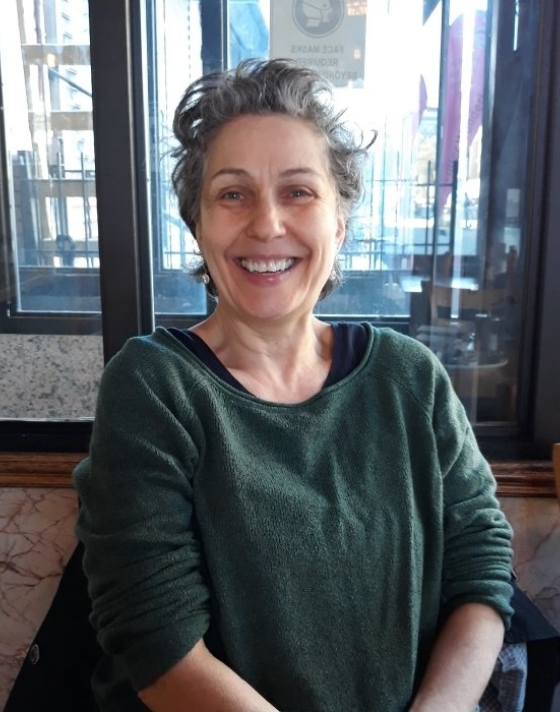
C.O. Besides loving books with pictures (which is pronounced “picha” on the Lower East Side), mushing photos and story together came out of crisis. I was shooting an experimental video on New York and my mother, Florence, a concert pianist who hid a sixty-year love for another woman and finally came out late in life. She was a unique, interesting character. That she was my mother was beside the point. She was just great material.
Everything I was doing suddenly stopped when she was suddenly unable to care for herself. Within 24 hours, my sister and I were scrambling with caretaking.
I couldn’t physically take care of Florence while holding a video camera -they were big in those days and smart phones didn’t exist.
I did have a small point-and-shoot that I could use with one hand and then slip into a pocket. And I always had a notebook/journal in my pocket as well. Florence was never short of amazing comments so I started jotting stuff down in between all the scrambling we were doing.
One day after taking care of Florence, I was walking home and saw a young man in a pork-pie hat smirkingly talking to a big video camera about NYC egg creams, saying stuff that was insulting and condescending.
Pissed me off. But I also realized that if I wanted the story of my city told right, then I had to do something about it.
That moment of “Hey! This is my home you’re talking about” and Florence just being herself, along with a point-and-shoot camera, morphed into It Was Her New York.
Norm: Your mother’s vivacious personality is vividly depicted in the book. What did you learn about her—and yourself—while writing it?
C.O. I learned we both were incredibly complex, fiercely determined, persevering women who refused to be defined by insulting clichés and stereotypes, including but not limited to: female, old, middle-aged, Jewish, Lesbian, artist/musician, mother, daughter. Those words described WHAT we were, but not WHO we were
And with Florence specifically, I learned who she was as a little girl because that was so much of what emerged at the end.
At the same time, Florence’s amazing sharp funny soul emerged more and more as her dementia burned away all the survival habits she learned.
She was actually sweet and caring, not words that I’d use to describe her as an unhappy gay woman in a straight marriage who was not living her life as a pianist and artist.
As her dementia
progressed, she returned to who she was if only the world loved
women, gay girls, poor people, daughters of immigrant Jews… And
watching her, I learned by example to be myself, to interact as who I
was, not what I thought the other person wanted me to be.
Norm: How did you balance capturing the deeply personal story of your mother’s decline with the broader themes of a changing Lower East Side?
C.O. Oh, it ONLY took eight, maybe nine or was it ten drafts of the book? And a great editor, Deb Heimann who worked with me for several years.
I pulled about 30 posts from the 1400 stories of the blog that Her New York was based on. The common thread was the way that Florence — and my neighborhood and city — were disappearing, while at the same time, in an accent or an exchange or a meal at a diner, I experienced a wonderfully familiar and unexpected moment of home.
With magnets and my metal bookcases I lined up those stories on index cards and put them in the structure of a four-movement piano sonata.
Because I learned music before I could read or write, I went from story to story as if it was music – the soundtrack to a night walk through my city. I added and subtracted stories, moved them around and those drafts grew and filled in the story of Her New York.
Norm: You describe the book as a memoir married with a graphic novel. How did this format evolve during the creative process?
C.O. Because Florence-care was so much of daily life in between my 30-hour-a-week job, video shooting and long-form writing were impossible.
I had
enough time to capture an image I wanted, jot a note of yet another
funny or profound thing Florence said or a colleague said or a person
on the street said and then collapse into bed.
After witnessing the pork-pie hat young man, I began putting up a story here and there on a blogspot. But it was unstructured and undisciplined.
At some point, I had to ask myself why wasn’t I taking a picture of what I was writing about? And why wasn’t I writing the story of the picture I took? And if I was really serious about telling stories of home, how was I going to do it?
So, I designated Tuesday and Thursdays as Florence and/or New York stories and Sunday as Sunday Memories because Sunday afternoons always felt so filled with regret and nostalgia. That structure got the ball rolling.
Norm: Your mother’s story is central to the book. What was the most challenging aspect of portraying her journey with dementia?
C.O. To make it a story NOT about dementia but about a woman-girl’s heart, soul and expression and her fierce desire to live as all the amazing words she was – Jewish, pianist, old, Lesbian, smart – while dementia ate her brain.
Her story is that of a PERSON, not the usual ‘women’s stories’, where our lives are squashed invisible or interpreted by the male-gaze/interpretation.
(I love Reese Witherspoon’s speech about the sentence women characters are always given - “What are we going to do?” i.e., we’re so cute and palatable when we’re helpless. Please google it – it is wonderful.)
Norm: Can you tell us more about the role of photography in the book? How did you choose the images to complement the narrative?
C.O. Almost all the pictures belong to the moment of the matching story. But I don’t know what came first most of the time – the chicken or the egg.
My camera and a notebook were always in my pocket. Sometimes Florence would say something, and I’d write it down and take a picture. Sometimes I’d take a picture and the story would emerge.
Norm: What role does humor play in your storytelling, particularly when addressing such poignant and difficult topics?
C.O. Honestly, I
wasn’t trying to be funny. I was just documenting the shit
hitting the fan. In fact, what I found funny made others cry.
And visa versa.
Florence was just saying what she thought and I was just writing about that moment.
And, OK maybe I’m biased, but that’s why you have all these social media posts, like “New York Overheard” and why the New York Times Metropolitan Diary is so popular. We just tell it like it is, without violins playing.
Norm: The Lower East Side is as much a character in your book as the people you portray. How has the neighborhood’s transformation influenced your writing?
C.O. I had a wonderful mentor years ago who suggested that my heart wasn’t breaking; it was breaking open.
That “reframing” was often front and center while watching my neighborhood melt away into unrecognizable streets that didn’t and don’t welcome the kind of people who made this city great – working class, immigrants, middle class, artists.
So, as I documented both my mother’s and my home streets melting away, my heart broke and my heart broke open and out came story and picture and life and death.
The more I put together these pictures and stories, the more I was determined to stand witness to the collective “us” that made our home such a great neighborhood and such a great city.
Norm: How did caregiving for your mother reshape your perspective on family, resilience, and love?
C.O. It healed both
of us in so many ways. That took what I describe as a horrible
yoga stretch. I hate yoga. I do it occasionally, but I hate
it. And yet I know I am stretching into health.
I had to redefine “family” and my role with Florence. She and I had a contentious dynamic from the earliest time I could remember, and we also shared the same fire inside. Like many kids, as I set up my own life, I muffled connection with my family.
When she got sick, I struggled. I was also engaged to be married at the time and my then-partner, having returned to his home country, was making other plans but not telling me.
So, I was attempting to keep a
relationship alive (over very old internet systems) and take care of
Florence, who was furious at being incapacitated.
But I have a rigorous Buddhist practice and, as we say on the Lower East Side, it don’t play. You either do it or you get the fuck out.
In the beginning it was around-the-clock mettas and chanting, a lot of yoga, tons of brisk walks to and from work in midtown. Nonstop.
There were
days so bad, I’d go home and kick the wall in frustration and anger
and grief (tip: wear a boot, use your heel). Also, really good
Chinese noodles and watching Robin Williams, Margaret Cho and Michael
Palin on VHS tapes from the library.
And then one day I noticed I was feeling different - there was patience and space and what is often described as the priceless gift of serenity.
Care for Florence became parental and supportive and filled with love and compassion. That process taught me how resilient I and strong I was, no matter what was happening.
When dementia steps in, you gotta give up the ghost of having your parent still your parent. And if you never really had that parent in the first place, a lot of pissed-off feelings come up.
Thanks to my Buddhist practice, I transformed those pissed-off feelings into acceptance of who and what she was. Like spiritual weightlifting.
The weights got
heavier; I got stronger. And the stronger I got, the more I was able
to love and care for her. There were still good days and bad – so
what? This wasn’t a Hallmark movie.
A couple of weeks before she died, she told me for the first time she loved me. It wasn’t a mother telling a child that. It was a child telling a parent that and that was her love for me and she got loved back in that moment.
When she died a couple of weeks later, she died feeling loved. Someone who had such a shit life, filled with violence, poverty, loss and disappointment but who survived, she died feeling loved. Who wouldn’t want to die like that?
More people I loved died after Florence and that fiancé was long gone and a lot of loneliness took his place.
Yet, that time with Florence and the healing from caring for her made me strong and open and willing to love again and fail again and then love again and no matter what was going right or wrong, it made me much more available to the people in my life. And then I met the person I was to marry. Wouldn’t have been possible without all that went before that meeting.
Norm: How has your relationship with the concept of memory evolved through this process, both as a writer and as a daughter?
C.O. I am much more open to allowing memory to bubble forth without a raging terrified interrogation of DID THAT REALLY, REALLY HAPPEN, UH??? I stopped thinking I had to present evidence in court.
I now let my
memories sing the way they want to sing.
These days, I’m writing my emotional memories of the violence on the Lower East Side, which, growing up, was not defined as such.
It was defined as normal life and get over it or hit ‘em back or hide in the library or it’s no big deal or tell no one.
As I write this new material, these emotional memories are pouring into events that maybe didn’t happen exactly that way but felt that way. And when I write about upsetting events that did happen like that, I am gentler with myself.
Norm: Where can our readers find out more about you and It Was Her New York?
C.O. I am on Instagram and Threads under @comoed0912, Facebook, LinkedIn and Bluesky where I post announcements of events and achievements and where I repost stuff from some of my favorite writers.
I also have a WEBSITE – www.comoed.net – which I update with new work and announcements.
Norm: What is next for C.O. Moed?
C.O. I am working on two projects – a collection of shortform pieces with the working title of The Consequences of Penises and Other Sudden Moments which I hope to have ready for publication in 2026 – and a fiction book of murder and revenge, yet to be titled. That will probably be ready in 2027.
I am also preparing the infrastructure of returning to experimental video for what was originally It Was Her New York. With 50+ hours of footage, I want to recreate the many night walks I have taken for decades throughout my city.
Norm: As we end our interview, what advice would you give to others who are navigating caregiving roles while trying to maintain their own identity?
C.O. What a great
question. Thank you! First and foremost, KEEP GOING!!!!
DON’T STOP!!!! If you have to write a note while sitting on
the toilet, do so. If that is your day’s work, YOU HAVE
WON!!! One sentence counts. One picture counts. Celebrate
it, congratulate yourself.
Another thing I did was I started saying no to everything that wasn’t Florence, job, failing relationship, writing that one sentence – yes even in the bathroom. Those things came before any emails to friends, any coffee out, any social anything.
Caring for someone is like being in a huge wave and paddling like crazy to not drown. There are good days, bad days, days of kicking walls and days of Chinese noodles.
So, whoever you are and whatever is going on, look at the seconds or minutes of the day where you can write that one sentence, take that one photo, draw that one line – whatever your art form is.
Each time you do that, you are putting a
mirror in your face and remembering who you are. Whatever you
do, don’t give up. The world needs your story.
This was great fun! Thank you, Bookpleasures!
FOLLOW HERE TO READ NORM'S REVIEW OF IT WAS HER NEW YORK