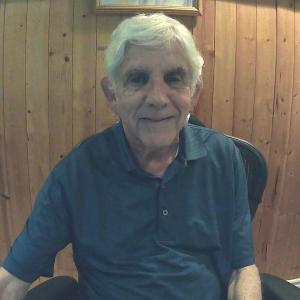
Reviewer & Author Interviewer, Norm Goldman. Norm is the Publisher & Editor of Bookpleasures.com.
He has been reviewing books for the past twenty years after retiring from the legal profession.
To read more about Norm Follow Here

Robert has had an amazing career in writing, publishing, and exploring history. He has written for prestigious newspapers as the Times, Sunday Times, Telegraph, and Guardian.
He's also the editor of an important book called Drunk On Power: A Senior Defector's Inside Account of the Nazi Secret Police State.
This book, which comes out on September 28 from Eglantyne Books, reveals a story hidden for a long time. It's a fascinating book that talks about hidden history.
Bookpleasures.com is honored to have as
our guest publisher, journalist and author, Robert Temple,
Robert
has had an amazing career in writing, publishing, and exploring
history. He has written for prestigious newspapers as the Times,
Sunday Times, Telegraph, and Guardian.
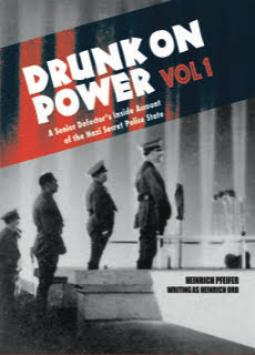
He's
also the editor of an important book called Drunk On Power: A
Senior Defector's Inside Account of the Nazi Secret Police
State.
This book, which comes out on September 28 from
Eglantyne Books, reveals a story hidden for a long time. It's a
fascinating book that talks about hidden history.
Norm:
Good day Robert and thanks for taking part in our interview.
Robert: It is a very great pleasure for me to be able to share the excitement of the discovery with you, and thank you for your interest!
Norm: What led
you to choose Heinrich Pfeifer's memoir for translation and
publication, given its unique focus on the Nazi "Deep State"
and his insider intelligence?
Robert: It is a commonplace to
say that the Nazi experience was a horrible nightmare, to point out
that millions died on the battlefield, and that millions died in the
Holocaust.
But to me this isn't just talk. I take it all personally. That is because I am a human living on this planet and I don't want it to happen again.
When I realized that Pfeifer was the ultimate insider who could tell us all about what happened and how it happened, I knew I had to make it widely known.
His account had been suppressed successfully for 78 years. But that suppression has to stop!
Norm: Can you elaborate on the process of locating and preserving the remaining copy of Pfeifer's memoir, and how did this contribute to its availability in English for the first time?
Robert: First I should
say that I did not know the name ‘Heinrich Pfeifer’ when I was
searching for the book. No one knew his real name.
He published the book in Switzerland in 1945 under the pseudonym of Heinrich Orb.
Somewhere ages ago I came across the information that a defector from the Nazi security services had published such a book under the name of Heinrich Orb, which was known to be a pseudonym, but that no one knew for certain who he really was.
And few people had ever really seen the book, and it appears in a few bibliographies just so that the authors can signal that they have heard of it, but it is clear that few have ever actually set eyes on it.
So I was searching for a book by Heinrich Orb, not by Heinrich Pfeifer. I discovered that most copies of the book had evidently been bought up and destroyed by Nazi sympathisers.
I spent years searching for a copy of the book. Because I never give up once I am on a trail, I finally found one for sale by a Swiss book dealer.
When I got it I saw that it was a real breakthrough, because the author had signed it with his real name and given it to a prominent friend, who was the commander of the Swiss Guards at the Vatican.
The author was a devout Catholic and moved in Catholic circles. Indeed, the only publisher in Switzerland with enough courage to publish the book was a Catholic publisher of religious books.
So when the author gave the book to his friend he signed it ‘Heinrich Pfeifer called Orb’. At last I knew his real name. I have published a scan of this signature page at the beginning of the book, to show the proof of his real identity.
Pfeifer had many aliases, at least twenty of them. He had to be so careful, because he was in constant danger of assassination. In fact, Pfeifer was finally assassinated by a Nazi vengeance squad in 1949. Aged only 44.
Norm: Could you
provide some insight into Heinrich Pfeifer's motivations for
defecting from the Nazi regime, considering the risks associated with
such a decision?
Robert: Pfeifer was never a real Nazi. He
was an anti-Communist nationalist. He had read all the works of Karl
Marx, Friedrich Engels, and Lenin.
He came to the conclusion that Communism was evil, so in 1929 (four years before Hitler came to power), when Pfeifer himself was only 24, he discovered that there was an Anti-Communist organisation.
He approached them and met the man who ran it and said, ‘I want to join up to fight Communism, to save Germany and the world’.
The man he was talking to was Alfred Rosenberg, Hitler’s great friend who was the chief ideologue of the Nazi Party and would later become the Minister for Foreign Affairs.
Rosenberg was impressed by the idealistic young man, especially when he discovered that Pfeifer knew various foreign languages including Italian, French, Spanish, and English, and had read every word of the Communist treatises and knew them all so well.
Rosenberg said to Pfeifer that he must not ‘join up’ and not even mention his real name to anyone. He told Pfeifer he wanted him to become his personal aide, and to adopt a false name.
So Pfeifer, who already had been using the false name of Friedrich Stein as a screenwriter in the German film business, chose the name of Heinz Stein for his work as Rosenberg’s aide.
Many months later Pfeifer joined the Nazi Party under a false name, perhaps Stein, perhaps another one.
He did this only because he was ordered to. Having become ‘one of the gang’, Pfeifer was used for espionage work in the field. He turned out to be a brilliant field agent.
He joined the French security service known as the Deuxieme Bureau under the false name of Henri Bauer of Alsace, and acted as a German double agent.
He was gathering information all around the disputed area of the Saar, which meant that he worked with Josef Buerckel, who later became a senior Nazi.
Pfeifer was expert at pretending to be a tramp in rags, wandering from town to town but really gathering intelligence. He also infiltrated various Communist and Trotskyite organisations.
He was so good at this, with his complete knowledge of the relevant texts, that he was asked to become the head of the Trotskyite movement in the area.
Meanwhle, Pfeifer’s old school friend Werner Best was becoming involved with the Nazis. He asked Pfeifer to come with him to Munich to meet his new friends who were named Himmler and Heydrich.
Heydrich
was Himmler’s deputy and ran the security service of the SS, known
as the SD. Himmler and Heydrich hired Pfeifer instantly.
He worked directly under Heydrich and was given an important office called ’the special Stein Bureau’ to handle counter-espionage, foreign operations, and ’special projects’.
Then they all moved to Berlin. As for Werner Best, he was later to become Deputy Head of the Gestapo, which was the police division of the SD.
Pfeifer was present at the dinner held for Roehm, the head of the SA, by his ‘friend’ Himmler, the warm hugs, the pledges of eternal devotion, etc.
But the very next day the Night of the Long Knives began, and soon Roehm was murdered in his jail cell. It was the shock of this duplicity and murderous violence that turned Pfeifer against the regime.
From then on he knew he had to get out. He had never been anti-Semitic, he hated the very idea of the concentration camps, and he came to realize he was working with dangerous psychopaths.
But he could not quit, because he would have been instantly executed. So he began the lengthy and slow plan for his escape and for his eventual actions to fight the Nazi regime.
He finally pulled it off in September of 1938, and immediately set to work exposing Nazi agents abroad. He flew to London and exposed the two top Nazi agents there, who were duly deported in 1939 by Robert Vansittart.
Vansittart used much of Pfeifer’s information in his struggle to oust Neville Chamberlain and get Winston Churchill into power.
He also gave the information to friends in America, to help encourage America to enter the War.
The emigre Curt Riess used much of Pfeifer’s material in his famous book TOTAL ESPIONAGE, intended to warn the American public of the true international situation and just how dangerous Nazism really was.
Norm: In the book's
description, you mention that Pfeifer names the heads of the Nazi
"Deep State" and describes their infiltration into
institutions worldwide. How did he manage to gather such detailed
information?
Robert: Pfeifer was the most senior defector
from the Nazi ‘Deep State’, as he jointly ran the SD department
dealing with counter-espionage and foreign operations.
He had also worked closely with the Abwehr and knew their agents too. He knew most of the Nazi leaders including Hess. He had had close associations with Hitler for a brief period also.
He had a photographic memory and knew the names of all the most important Nazi agents abroad, and personally ‘ran’ many of them.
His defection was the most important ‘spy turn’ of the entire War. He had been personally assigned by Himmler to carry out the bugging of the home and offices of Himmler’s hated rival, Josef Goebbels.
He knew all
the secrets of all the top Nazis from his access to Himmler’s
personal files, many of which he had written himself. In short, he
knew everyone and everything relating to the Nazi ‘Deep State.’
He was never involved with military operations, but he knew all about
the personal lives of all the generals, and their rivalries. It was
his business to know everything about everybody. And he did.
Norm:
The memoir apparently contains descriptions of the personal habits,
nicknames, and actions of key SS figures. How reliable were Pfeifer's
recollections of these individuals, and what sources did he draw from
to provide such insights?
Robert: Pfeifer knew most or all
of them personally. He was a key figure and had access to all the
most secret files. He even tells us that those most secret files were
kept separate from all other SS files in a special underground vault
which he entered constantly in connection with his work. (Note: those
files have never been discovered and the vault remains concealed
under the streets of Berlin and there are reasons to believe it
survived the bombing.
But Pfeifer is the first person to tell us
about it, so it has never been searched for.)
Norm: The
inclusion of over 250 photos, many previously unpublished, is
intriguing. Could you share some details about the origins of these
photos and how they contribute to the reader's understanding of the
events and individuals mentioned in the memoir?
Robert: I
obtained every one of those photos personally, obtaining none from a
picture agency. Having obtained them one by one, you can imagine it
took a lot of work and ingenuity.
I estimate that considerably more than half of them have never before been published. Many are signed by the people in the photos and were given to friends. I presume it is the grandchildren who are selling all these things off, but I always get the photos and documents from middle-men and dealers. Sometimes unexpected things come my way.
For instance, I now have the original entire divisional records of the Parachute Division under General Student.
These include hand-drawn maps of every operation they carried out during the War, with original correspondence, lists of all the dead, etc., etc.
These records have nothing to do with the book. But I thought I ought to acquire and preserve them, as they are a priceless treasure trove of military history for a world war, after all.
As for the reader’s experience of the photos in the book, I tried to insert a photo of every person mentioned as the name came up, to enhance the reader’s experience by seeing the people who enter the story.
This adds a useful dimension, because you feel you know them because just as he is talking about them, there they are in front of you and you can have a good look. And often you can see their signatures too.
But the most disturbing thing is to look into their eyes. There are a lot of candid shots that show them interacting with one another. The pictures alone are a story in themselves.
For instance, I acquired a snapshot of Mr. and Mrs. Himmler in their overcoats out for a stroll, looking exactly like ‘Mr. and Mrs. Nobody.’
You could pass the mass murderer in the street and he and his wife (six or seven years older and once a nurse) would not receive a second glance.
They are the absolute apotheosis of what has been called ’the banality of Evil’. But this snapshot has never been published before. It explains a lot.
You
look at it and you think: 'THIS is the guy who was killing millions
of people?’ And you can’t believe it. You just can’t believe
it.
Norm: The endorsement by Robert K. Wittman
highlights Pfeifer's insider view of the Nazi state. How did
Pfeifer's perspective and revelations in the memoir align with or
challenge existing historical narratives about the Third
Reich?
Robert: Pfeifer’s revelations are astonishing in
countless ways. He finally gives the real account of the notorious
Reichstag Fire incident.
He reveals that it was originally the idea of Josef Goebbels, which no one had ever previously suspected.
And Pfeifer ought to know, because he was the man who was bugging Goebbels! Pfeifer felt sorry for the Dutch communist who was executed falsely for this incident, because the boy was autistic and retarded.
Pfeifer also tells the true story of the Night of the Long Knives, and who really killed whom. In fact, Roehm was killed by Sepp Dietrich, who was Hitler's personal bodyguard.
Pfeifer was an eyewitness of those events. He tells how Himmler out-maneuvered Goering to get control of the Gestapo away from him. And by the way, the Gestapo was not called the Gestapo at that stage, but was called the Gestapa.
He also informs us of Goering's maniacal personal brutality and delight in torturing people. If you want to know the inside story then you have to read Pfeifer.
Of course he knew all the nicknames, because he was in daily contact with all of these people, and knew the nicknames they were called behind their backs.
And he
tells us that Himmler’s scornful nickname for Admiral Canaris was
’the Geriatric’. He hated him.
Norm: Professor
Frank McDonough's endorsement mentions previously unseen documents
revealed in the book. Could you provide some examples of these
documents and their significance in shaping our understanding of the
Nazi police machine?
Robert: I was able to acquire some
original Himmler documents and analyse their significance. I acquired
an original postcard sent by Franz von Papen. I have a small diary of
one year of one of the Nazi leaders, Robert Ley.
And by the way, Pfeifer tells us that Ley’s real surname was Levi and he was Jewish, and his frenzied attacks on the Jews were partly motivated by the need to cover up the fact that he was one himself.
But it is
mostly the information provided by Pfeifer, meticulously detailed as
it is, that is crucial. I can honestly tell you that a proper
understanding of the security service of the SS is impossible without
reading what Pfeifer tells us.
Norm: Where can our readers
find out more about you and Drunk On Power: A Senior Defector's
Inside Account of the Nazi Secret Police State?
Robert:
Publication is on September 28. And Volume Two is coming out next
year, which will contain much more information from documents.
And I hope that the voluminous files on Pfeifer which are still classified in America will be declassified.
As Pfeifer apparently wrote at least 62 lengthy reports for American military intelligence after his defection, they could probably fill several volumes.
I can see no reason for the continued classification of the Pfeifer files, the file numbers of which I have. And since Pfeifer worked for at least seven intelligence agencies, this could run and run and run.
Pre-order your copies from Amazon. And you can always get one quickly and directly from Eglantyne Books just in case your local bookshop is sleepy.
It is a big hardback, 535 pages, on good paper so that you can see the photos properly. Even the cover photo has never been seen before.
We have kept the price low (only £25 in
the UK) because this is not a project which has been done for profit,
it is for the good of civilization, and for full public
knowledge.
Norm: As we wrap up our interview, what do you
hope readers will take away from Drunk On Power: A Senior
Defector's Inside Account of the Nazi Secret Police State?
Robert:
This is just the beginning. Until I got that book from a Swiss book
dealer, the only people who knew the name of Heinrich Pfeifer were
the most senior intelligence officers such as Robert Vansittart and
Allen Dulles.
So without the name, no one could request any files. This is a gigantic story which if followed through will create an entire chapter in the history of the middle of the twentieth century.
It is enough to keep many historians busy. And there is direct relevance to the present as well. Pfeifer's X-ray of the Nazi Deep State is so complete and detailed that we can see every aspect of it.
And it is more or less a replica of the security services of Russia today. Heinrich Mueller, the Head of the Gestapo, fled to Russia at the end of the War and created a duplicate organisation there to the one he had been forced to abandon in Germany.
So if you want to know what Putin will do next and how he will do it, read Pfeifer. I believe in an informed public, especially on matters of world importance.
I therefore want everyone in the world to read Pfeifer and to do so right now. And by the way, I did not get paid anything for editing the book and all that work.
Some people don't just do things for money. I am one of those starry-eyed idealists. Let’s hope that you are too.
Norm: Thanks once again and it has been a pleasure to talk to you.