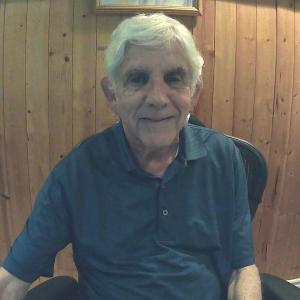
Reviewer & Author Interviewer, Norm Goldman. Norm is the Publisher & Editor of Bookpleasures.com.
He has been reviewing books for the past twenty years after retiring from the legal profession.
To read more about Norm Follow Here

Bookpleasures.com once
again welcomes as our guest Michael Kenneth Smith whose recent
novel All is Fair has just been published.


Norm: Good day Michael and thanks once again in taking part in our interview.
What do you consider to be your greatest success (or successes) so far in your writing career?
Michael: I initially thought I wrote for myself. Writing is time consuming and I experience a lot of pleasure creating scenes and developing characters.
However, as time goes by, hearing and reading my readers' reactions and comments has superseded that.
So, I consider my greatest success thus far my readers' favorable responses to the products I publish.
Norm: Why have you been drawn to historical fiction?
Michael: By setting a story in a historical context, several things can be accomplished.
First of all, history marches to the beat of time…a time in the past and that enables me as an author to fit the story into a particular historical reference.
I always try to be sure the historical reference is accurate so my readers can not only enjoy a good tale but also learn some historical facts previously unknown to that reader.
Norm: Do you believe it would be beneficial to have students in high school read historical fiction to understand history.
Michael: Generally speaking, raw history can be boring and difficult to learn. But if the history can be made appealing and interesting, then teaching history can be much easier.
Also, there is an old saying that reading raw history will tell you exactly what happened and reading good historical fiction will tell you how it felt at the time.
Norm: In fiction as well as in non-fiction, writers very often take liberties with their material to tell a good story or make a point.
But how much is too much?
Michael: Changing fundamental, well known history to make a plot work is too much. If there is such a change, then the work ceases to be historical fiction (IMHO).
Norm: In your opinion, what is the most difficult part of the writing process?
Michael: Getting started, by far. Whether it be the first chapter or a new scene, the first words or sentence of the day are the toughest.
Once I get started, the scene develops quickly in my mind and the words flow.
Sometimes I have no idea where the scene is going but it’s a joy to let it flow onto the page.
Norm: How did you become involved with the subject or theme of All is Fair?
Michael: This question has several answers.
First of all, some would say the Battle of Britain would have had a different outcome had not the Polish pilots participated.
Namely the famed RAF 303 Squadron composed exclusively of Polish fighter pilots took a steep toll on the Luftwaffe.
These Polish pilots, consumed by their search for revenge for what the Germans did to their homeland, fought with fierce determination and bravery.
Secondly, as a pilot myself, I wanted to learn about the characteristics of the planes they flew and those of their German adversaries so I could write accurate descriptions of aerial combat.
I downloaded images of each of the instrument panels and cockpit environments of all the planes described so I could better describe what the pilots were doing and their limitations.
Norm: How did you decide on the title?
Michael: The title, All Is Fair, is half of the old expression which included ‘in love and war’. The title is apt because during a war moral and ethical codes became less clearly defined to some people.
Near the end of All Is Fair, the title becomes perfectly logical.
Norm: What was one of the most surprising things you learned in writing All is Fair?
Michael: Several things.
One is I learned that the Luftwaffe, particularly the pilots, were largely composed of aristocratic Germans who may not have been staunch Nazis and considered air combat more of a game or contest.
Secondly, I learned that the British were very good at prepping for war and also executing same.
They had a system while not always perfect that made them a fierce adversary.
Norm: How much research
went into writing the book? What are some of the references that you
used while researching this book?
Michael: Researching each of the planes discussed in this book took a significant amount of time. This material is all available on various websites that cater to English, French and German vintage aircraft.
The research for scenes involving German POW interrogation techniques came from a biography of a famed German interrogator Sharf.
Norm: What were your goals and intentions in this book, and how well do you feel you achieved them?
Michael: My goals in writing are always the same: create a very interesting story while informing the reader of historical facts.
Thus far, most of the reviews of ALL IS FAIR, have commented about how well the book has been researched.
Norm: How did you create the character of Jan Orlinski?
Michael: This book is basically a loss of innocence story about a young, brash, talented man learning that his life may not pan out the way he had initially envisioned. The main character, Jan Orlinski, ever so slowly comes to that realization.
Norm: What was the most
difficult part of writing this book?
Michael: The ending.The last chapter went through many iterations and nuances before it came out as it did.
Norm: Did you know the end of your book at the beginning?
Michael: No. I knew the circumstances under which the story would end but I did not know exactly how the main character would react to those circumstances.
Norm: Do you hear from
your readers much? What kinds of things do they say?
Michael: I consider reader feedback as very important learning and try do write better with each book.
I do enjoy a wide number and assortment of friends many of whom give me very positive feedback. Other feedback comes via reviews and nearly all have been very positive.
Norm: Where can our readers find out more about you and All is Fair?
Michael: MY WEBSITE , contains a lot of personal information plus some of my other writings.
More info on this book can be found on Amazon, or Google my name.
Norm: What is next for Michael Kenneth Smith?
Michael: Several things. First is the next book which will most probably be a sequel to ALL IS FAIR, but will stand its own.
Secondly, a previous WW2 novel I published several years ago, THE POSTWOMAN, will get rewritten to include new evidence about the main character Andree de Jongh.
She may have been a lesbian and I want to modify her story to include that evidence.
Norm: As this interview comes to an end, if you could invite three authors of historical fiction (dead or alive) who would they be and why?
Michael: May I take a little liberty with this question?
The late Shelby Foote comes to mind. He did not write historical fiction, only history.
But it was his narrative style that was so appealing. His prose read like a story without any fiction. He was a treasure.
Also Bruce Catton for the same reason.
The third, who was an author a plain fiction not historical, would be Earnest Hemingway because he was very frugal in the number of words he wrote to tell a story…a characteristic I would like to emulate.
Norm: Thanks once again and good luck with all of your future endeavors
FOLLOW HERE TO READ NORM'S REVIEW OF ALL IS FAIR