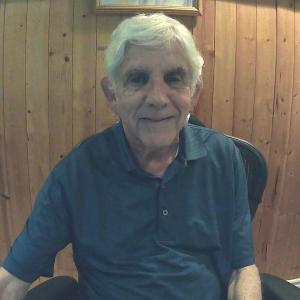
Reviewer & Author Interviewer, Norm Goldman. Norm is the Publisher & Editor of Bookpleasures.com.
He has been reviewing books for the past twenty years after retiring from the legal profession.
To read more about Norm Follow Here

Bookpleasures.com welcomes as our guest Jeffrey Lyons. Jeffrey has reviewed more than 15,000 movies, 900 Broadway and off-Broadway plays. He has interviewed over 500 actors, co hosted three national movie review shows—Sneak Previews, MSNBC’s At the Movies, and Reel Talk—in his forty-five-year career continues in television, radio, and print. Jeffrey is the author of Stories My Father Told Me and the co-author of 101 Great Movie for Kids, as well as three books of baseball trivia, Out of Left Field, Curveballs and Screwballs, and Short Hops and Foul Tips.
He has recently published Hemingway and Me: Letters, Anecdotes, and Memories of a Life-Changing Friendship.

Bookpleasures.com welcomes as our guest Jeffrey Lyons. Jeffrey has reviewed more than 15,000 movies, 900 Broadway and off-Broadway plays. He has interviewed over 500 actors, co hosted three national movie review shows—Sneak Previews, MSNBC’s At the Movies, and Reel Talk—in his forty-five-year career continues in television, radio, and print. Jeffrey is the author of Stories My Father Told Me and the co-author of 101 Great Movie for Kids, as well as three books of baseball trivia, Out of Left Field, Curveballs and Screwballs, and Short Hops and Foul Tips.
He has recently published Hemingway and Me: Letters, Anecdotes, and Memories of a Life-Changing Friendship.

Jeffrey: It's actually 50+ years as a professional movie critic on TV, radio and in print. I had an amazing childhood in which visitors to our home included Dr. Ralph Bunche, Sir Alfred Hitchcock, Orson Welles, Ernest Hemingway, John Steinbeck, Barbra Streisand, Marlene Dietrich and Joe DiMaggio among many others.
All because my father Leonard Lyons, wrote THE "must read" column "The Lyons Den" six days a week in the NY Post, back then a very different paper; i.e. liberal. It was NOT a gossip column; that was Winchell and others. Carl Sandburg said if there'd been a LYONS DEN back in Lincoln's time, we'd really have known what went on.
Three of my nine books (nine including my other book which also came out this May 1st, The Boston Red Sox All-Time All-Stars are about my father's era in NY and the incredible array of people he knew and about whom he wrote.
Norm: What do you feel is the most overrated virtue and why?
Jeffrey: "Celebrity," My father wrote some 12,378 columns and used "newsworthy" but never the word "celebrity" even once.
Norm: What do you consider to be your greatest success (or successes) so far in your writing and interviewing career?
Jeffrey: I had a long one-on-one radio interview with Betty Davis, long TV interviews with Mel Brooks, Robin Williams, and conducted Penelope Cruz' first interview in English after helping her get over her nerves by interviewing her first in her dialect of Castillian Spanish which I also speak.
When George Clooney came by my set at WNBC plugging "Good Night and Good Luck," about Edward R. Murrow, I played a clip of my family being interviewed by Murrow for his other show, "See it Now." (It's on YOUTUBE) in December, 1955.
When Salma Hayek came by plugging "Frida" I showed her a color drawing Diego Rivera did in a book for my father.
The word got around that I did in-depth research with questions no one else knows. When I did my first interview with Antonio Banderas, I came in humming the music they play only in the bullring in Malaga where he'd been an usher as a young man, then did the public address announcement including the ad for the local beer. Then I rattled off the names of the tiny towns nearby where he was a street performer; I'd been in those towns. The lost goes on.....
Norm: What has been your greatest challenge (professionally) that you’ve overcome in getting to where you’re at today?
Jeffrey: TV doesn't like men with white hair; you get to a certain age and you're gone. There are exceptions, but thank goodness for radio, where I still record and syndicate 5 movies and movie commentaries a week and also 5 baseball trivia questions sent to sports stations.
Norm: In your opinion, what is the most difficult part of the writing process?
Jeffrey: David Niven (who deserved a knighthood) said "applying the seat of the pants to the seat of the chair" but I've never had writers' block.
Norm: What
did you find most useful in learning to write? What was least useful
or most destructive?
Jeffrey: I have no
answer for that. Learning to type early on, I guess in college when
others did hunt-and-peck on a keyboard. My older brother asked Ernest
Hemingway how do you write a novel when we visited the Hemingways in
Cuba. "Keep your sentences short," replied the greatest
novelist of the XX century, and pretend the words are being tattooed
on our back. That'll keep your sentences succinct and to the
point."
Norm: How did you become interested in reviewing movies, plays and interviewing actors? As a follow up, how do you live with the way people interpret and analyze your reviews?
Jeffrey: My godmother was Madge Evans, the MGM star of the 'Thirties ("David Copperfield, " "Dinner at Eight") and her husband, Sidney Kingsley, the Pulitzer winning playwright ("Dead End" in which he created "The Bowery Boys" inspired me.
So did another older brother Warren Lyons who was an Obie Award winner for producing "The House of Blue Leaves". I took acting lessons from Lee Strassberg, Marilyn Monroe and Paul Newman and Lee J.Cobb's teacher.
So I came prepared for my first job at WPIX-TV in 1970.
I just do my job and move on to the next movie or play. Mostly movies in recent years.
Norm: What is the most memorable interview you have ever conducted and why?
Jeffrey: Bette Davis, Mel Brooks, Robin Williams, Sofia Loren (who'd cooked me a spaghetti dinner when I was eleven in Madrid), Richard Burton (who lived in our building and who I taught how to bunt and thus move the runner along in baseball); Carole Channing, who remembered me as a boy; George Clooney, George Carlin, Peter O'Toole, old friend Kirk Douglas (four times, and he told me I knew more about his career than he knew!) Zero Mostel, and many others.
Also Oscar Robertson, one of the greatest basketball players of them all, and Luis Tiant,l the great Cuban Boston Red Sox pitcher who had a movie about his life). Many others.
Norm: What advice can you give aspiring writers that you wished you had received, or that you wished you would have listened to?
Jeffrey: I was lucky; my first job in TV was in the number one market. Get in print. Save your reviews. Have a resume ready. Read the trade papers to see available jobs.
That's how I learned that PBS was looking for replacements for Siskel and Ebert and I won the auditions beating out 150 others and we beat them in the ratings quite regularly.
Norm: How did you become involved with the subject or theme of Hemingway and Me: Letters, Anecdotes, and Memories of a Life-Changing Friendship?
Jeffrey: He and my father became friends around 1937 and corresponded regularly. He trusted my father and would send my parents the first copies of his new novels to get their reactions. We were their guests at their farm near Havana.
When Mary found her father's body, in fact, she called my father before the authorities and he told the world. Then in 1956, I went with my parents to Spain and Richard Condon, who wrote "The Manchurian Candidate" and "Prizzi's Honor" took us to a bullfight and explained it all.
I was transfixed. Soon after that, Orson Welles gave me a primer as did Daryl Zanuck, head of XX Century Fox, up in Pamplona where he was filming "The Sun Also Rises." By 1961, I'd been back to Spain and lived with a Spanish family to learn Spanish to understand bullfighting even better.
Then in
June, 1961,a month before he died, Hemingway, aware of my deepening
knowledge of "the bulls" arranged with his godson, Antonio
Ordonez (son of the bullfighter on whom Hemingway based the character
of "Pedro Romero" in "The Sun Also Rises") for me
to travel with Antonio for two weeks. It turned into seven summers,
and 35 subsequent trips to Spain where we have lots of friends,
including breeders and others in that world. Then in 2,000, my son
Ben traveled with Antonio's grandson Francisco Rivera Ordonez (featured in two stories on "Sixty Minutes" with the late correspondent Bob Simon. viewable on You Tube as "Blood Brothers."
Norm: What were your goals and intentions in this book, and how well do you feel you achieved them?
Jeffrey: It presents an intimate side of Hemingway and the unusual friendship between these two disparate friends.
Norm: Could you tell our readers something about the book?
Jeffrey: It's a collection of letters from him and interviews and reminiscences and a bit of my adventures with Antonio Ordonez,
Norm: Where can our readers find out more about you and Hemingway and Me: Letters, Anecdotes, and Memories of a Life-Changing Friendship
Jeffrey: In the book!!!
Norm: What is next for Jeffrey Lyons?
Jeffrey: Not sure. I have that other book about the best Red Sox players at each position, filled with stats, trivia and background about what made them great. Also strange players, odd achievements, etc.
Norm: As this interview comes to an end, if you could change one thing about the world what would it be? How would it change you?
Jeffrey: No more terrorists, foreign and domestic. More people going back to reading books, while still enjoying TV, movies and the good aspects of social media.
Norm; Thanks once again and good luck with all of your endeavors