
Reviewer Bani Sodermark. Bani has a Ph.D in mathematical physics and has been a teacher of physics and mathematics at the university level in both India and Sweden. For the last decade, her interests have been spirituality, healthy living and self-development. She has written a number of reviews on Amazon. Bani is a mother to two children.
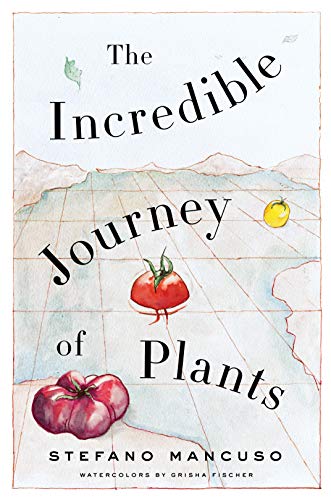
Author: Stefano Mancuso
Publisher: Other Press
ISBN: 978-163542991-6
Author: Stefano Mancuso
Publisher: Other Press
ISBN: 978-163542991-6
Plant Sentience
This is a delightful book to read and re-read. It points to the number of aspects of the plant kingdom that are largely left unseen by the human race, when compared with the more physical observability of the animal kingdom of which the human race is a part. This book is an attempt to set the balance right, in showing that the plant kingdom is in no way inferior to the latter. The former is, in fact, even ahead of the latter when questions like resilience and longevity are concerned. Trees live longer than we do, unless they are cut down.
The world famous conservationist Jane Goodall once said in one of her many books that she had been approached by the plant kingdom to highlight them and their contribution by writing a book in the same spirit that she had done for chimpanzees. It appears that this author,Stefano Mancuso, has taken up the assignment, i.e. to show that plants are in no sense, less sentient than animals and, in some cases, superior, as well.
As the author puts it, ”We are convinced that plants are not able to perceive their environment around them, while, in reality, quite to the contrary, they are more sensitive than animals. We are sure that plants belong to a silent world, deprived of the ability to communicate, but instead, plants are great communicators. We are convinced that they don’t carry on any kind of social relationship, but quite the opposite, they are exquisite social organisms. We are, above all, absolutely certain, that plants are immobile….. Actually we’re wrong about this one too. ...They move a lot, only at a slower pace. What plants are unable to do is locomote, or move from place to place in their lifetime. The adjective that defines them should not be “immobile”, but “sessile” or “rooted”.
The material in this book is arranged as follows.
The author starts off by showing how plants are not inferior to animals, they are just different. He provides a foretaste of the contents of this book that are to be explored in the ensuing
sections.
In the first section, the author presents a few instances where plants should be rightfully regarded as the ultimate in pioneering organisms. To this end, the author provides evidence of the capacity of plants of their capability to “prepare the way for subsequent colonization by other living beings. This is because there is no terrestrial environment in which vegetables are not able to take root, bringing life along with them”. The author provides interesting snippets of information where plants have managed to colonize deserted and inhabitable areas, one prominent area being Chernobyl. The other cases taken up for discussion are Surtsey Island and Japan where there was a tree that was revered because it had withstood the onslaught of the atomic bomb in Hiroshima.
In the second section, the author explores the role of fugitives and conquerors. Starting with the fascinating story of how the tomato came to Italy and became an ingredient in Italian national cuisine. The author also details the interesting story of how the characteristic yellow flowers of the plant, Senecio Squalidus from Sicily came to the UK. The pink flowering plants of Pennisetum have a similar story, it came as a fugitive from Abyssinia to Sicily and ended up as a conqueror.
The next section deals with how plants propagate to different lands. It appears that Darwin conducted experiments to find out how plants transmigrate to distant lands, either by air or water. Two examples are studied, viz. the coconut palm (Cocos nucifera) and the sea coconut(Lodoicea maldivica), Very interesting stories relating to their appearance in distant lands are told in this section.
At this stage of the book, the author takes up the story of how the seeds of a plant can survive millenia and still germinate, given the right environment. From now on in the book, the narrative focuses on human beings, who set the scenes in which plants play a winning role.
The next section is about how, in areas of extremely inhospitable terrain, one single tree has successfully withstood the elements and stood firm, despite weather conditions and human intervention.
This book took me back to my childhood, when I believed that everything was possible. The stories in this book and there are many, are very evocative, they draw forth the adventurer and the miracle maker in you. It is a book, after reading which, you will never see plants the same way again.
Strongly recommended.