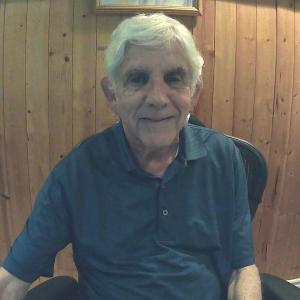
Reviewer & Author Interviewer, Norm Goldman. Norm is the Publisher & Editor of Bookpleasures.com.
He has been reviewing books for the past twenty years after retiring from the legal profession.
To read more about Norm Follow Here


Author: Michael Kenneth Smith
ISBN-10: 1098740130: ISBN-13: 978-1098740139
Author: Michael Kenneth Smith
ISBN-10: 1098740130: ISBN-13: 978-1098740139
One of the rewards in reading historical fiction is that it makes events and people come alive that is more inviting or personal than just reading a non-fiction history book of the event. When we humanize history, we have a better understanding of what transpired in the past.
This is quite apparent in award-winning author
Michael Kenneth. Smith's The Thin Gray Line where we have a
fictional tale around a young soldier, Luke Pettigrew during the
American Civil War.
As we read the opening pages of the yarn, we find
Luke lying awake on a bed in a stranger's farmhouse where he is
stunned when he discovers that one of his legs has been amputated.
Next, we encounter Clyde and Joanie McCallister, the
owners of the farmhouse where Luke is resting. Further on, we learn
how Luke arrived in their home after Clyde had found him unconscious
in a burned-out farmhouse, which apparently belonged to his parents.
We are also informed that when Luke was brought into their home, the
couple, to save his life, had no choice but to amputate his severely
injured leg as there was no doctor nearby.
While he is alert, Luke
recounts to the McCallisters that his combat injury occurred during
the Battle of Gettysburg. He also tells them that he was in the
Ambulance Corps in the Battle of Shiloh.
And that is just the beginning. Advancing further into the narrative, we learn that the Union forces over-ran Luke's small field hospital during
the Battle of Shiloh. Consequently, he was taken prisoner to a war
camp in Columbus, Ohio. Several months later he managed to escape
with the help of a prominent local citizen whose house he stayed in
and where he met the love of his life, Carol. Luke had promised Carol
that after the war, he would return for her.
Luke's next stop after Shiloh was Gettysburg where
he rode with the fearless cavalry commander Jeb Stuart. During the
battle, Luke was shot off his horse resulting in the shattering of
some of his bones.
Before joining the Confederate army, Luke was turfed
out of his farm home by his father, after he had accidentally injured
a horse that his father depended on to pull their buggy and help with
other work around their farm.
While living with the McCallisters and recovering
from his injuries, Luke is determined to help himself and refuses to
have a peg for a leg and succeeds in crafting a workable prosthetic
leg. Also during his stay, Luke meets Joanie's twin sister who one
night appears in his bed and seduces him believing that he is her
late husband Paul, who incidentally was Clyde's brother.
After leaving the McCallisters, Luke is determined to
carry on his life and get back into action helping wounded soldiers.
He sets out to rejoin the Confederate Army. While on his way to
Richmond, he encounters a spy for the Union Army, who surprisingly
turns out to be a woman, although she was dressed like a man. While
working as a medic and during a smallpox outbreak, Luke finds a way
to help the soldiers suffering from this dreadful disease. He also
becomes deeply attached to a little black girl, Posey, who has lost
her parents. Noteworthy is Luke's meeting with James Hanger, who was
the worldwide leader in the development and manufacture of prosthetic
devices, and, by the way, his company still lives on today with
branches around the world. Hanger invites him to manage his factory
in Richmond.
Quite simply, the story itself is thoroughly compelling, and as an
excellent historical fiction story, increasingly so up to its closing
pages.
Smith is also good at down-to-earth dialogue.
Listening to the exchanges between Luke, the McCallisters, Posey,
Hangar, Cuff, and with others, you feel you are eavesdropping on real
conversations. All of which makes the novel even more realistic. And
not but not least, as with all good historical fiction, readers will
learn a few things, as I did, that there was a female spy who came
from Canada and was helping the Union Army?
FOLLOW HERE TO READ NORM'S INTERVIEW WITH MICHAEL KENNETH SMITH