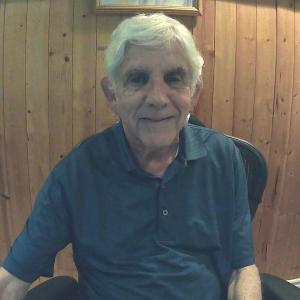
Reviewer & Author Interviewer, Norm Goldman. Norm is the Publisher & Editor of Bookpleasures.com.
He has been reviewing books for the past twenty years after retiring from the legal profession.
To read more about Norm Follow Here

Norm Goldman, Publisher & Editor of Bookpleasures.com Interviews Alvin H. Franzmeier
Author Of The Spiral Bridge, The Twins. and Freya's Child.
Click Here To Purchase Freya's Child
Today, Norm Goldman Publisher & Editor of Bookpleasures.com is excited to have as our guest, Alvin H. Franzmeier. Alvin is the author of two theological works: The First Words of Jesus—Meditations on the Eight Beatitudes and The Day of Rest. He is also the author of two prequel novels: The Spiral Bridge and The Twins. Freya's Child, his third in the Spiral Bridge Mystery Series, has recently been launched.
Good day Alvin and thanks for participating in our interview
Norm:
How did you get started in writing? What keeps you going?
Alvin:
To start with, thank you Norm for inviting me to participate in this interview.
My lifelong dream was to be a writer, but my duties as a parish pastor never seemed to allow me the time I needed. Sure I wrote as a pastor, but not what I’ve called creative writing. By that I refer to stories and memoirs. So when I stepped away from parish work, sermons, Bible studies, conference and retreats and all the counseling that goes with it, I turned to a longtime friend and a member of my former church, who had long been a writer. “Kristl,” I asked, “how does one get involved in this business of creative writing?” Like any good mentor she did two things. First she told me to read a half-dozen books and then she said I should start writing—every day.
“But what will I write about?” I pleaded.
“What you know, write about what you know,” she said.
And that’s what I did. I began to write about the places and times of my youth in southern Minnesota.
Oh, one more thing she advised me to do. She told me to join a small writers’ group, one that she had, in fact, started. I did that, but all those creative people! They intimidated me. Some were published novelists. Others had published short stories. Could I do that? They were kind, welcoming, but very demanding. They insisted I act and think like a writer. In order to “help” me, they began to take my work apart and then help me to put it together again. What a frightening, enlightening, unnerving, stimulating and disturbing experience that was. I wouldn’t have missed it for the world. But that’s another story.
What keeps me going now? The excitement of creating stories that never existed before. I still don’t know where they come from. I suppose that’s why the old Greeks called this creative process their Muse, a strange, hidden spirit who brings all this to pass. I don’t, because I believe creating in any form is a reflection of our Creator, His image built within us all. To be a part of that process and to have my readers celebrate it—well, that absolutely really floats my boat.
Norm:
I notice you are the author of two theological works and three mysteries. This is quite a switch! How did you become interested in mystery?
Alvin:
Yes, I know it seems like quite a switch. Theology tends to be very intellectual. Theologians aren’t given much to telling stories. It’s kind of like the difference between Athens and Jerusalem, between the Greeks and the Jews. The Greeks seek wisdom and love philosophy, but the Jews love stories and signs from heaven. My point: I’m a Biblical theologian and the Bible is packed with stories about peoples, nations, wars, families, intrigue, celebrations and all the great themes of human life. It really wasn’t a big switch, especially since I have always loved good stories, both those in the Bible and elsewhere.
As to writing mystery novels, well, Norm, nothing else seems to fit my bent. I sure couldn’t write romance novels, for instance. I love adventure and intrigue. I’ve always loved a good who-done-it mystery, especially those with a hidden, unexpected final twist at the end. And I love to see the good guys win, especially, I suppose, because it doesn’t always work out that way in daily life—or at least so it seems. As a Christian, I believe in the final victory of good over evil, but I know it doesn’t always seem so in the interim. Yet writing mysteries gives me a chance to hint at that, because in all mystery novels the good guy wins at the end, despite all odds to the contrary.
Norm:
Is your work improvisational or do you have a set plan?
Alvin:
What can I say? I’m sure not one of those writers who puts down every plot point on note cards to paste up on some board and move around as the novel progresses. For me the creative process is deep, hidden somewhere in my psyche. So I hear a general hint about the story boil up from somewhere and then sit down to be an amanuensis. I feel rather like someone taking notes while watching a good movie or play. Then I must write down what I see and hear going on. Each of my characters takes on a life of his own and I follow them around from one adventure to another. Strangely enough, most of them allow me into their thinking and feeling, but I feel like I’m always only a recorder. Talk about mystery. I don’t really know how all this happens. Somehow the whole story unfolds for me from day to day and week to week until I have a draft. The process amazes me. Where did that come from? If that’s improvisational, then that’s me.
Norm:
Freya’s Child is your most recent work of fiction. Could you
tell our readers a little about the book? How much of the book
is realistic? What kind of research did you do before writing the
book?
Alvin:
Like the other two novels, this book grew out of my research, meditation and the writing process. It’s based in Minnesota in 1939, a couple years before the United States entered World War II. Already in the second novel, The Twins, members of the German American Bund were slipping contraband weapons into the country in anticipation of Germany’s victory in Europe and planned attack of America. So what was next?
One member of a Twin Cities mob that had been assisting the Bund, escaped with some of the loot and was in hiding. From my reading I knew that the Germans called themselves Aryans and wanted to restore the old Vikings’ religion. Whoops! Minnesota is the home of the Vikings. Those ancient warriors were living there five hundred years before old Columbus bumped into the North American continent. In fact, one of the Viking rune stones had been discovered at the turn of the twentieth century in northwestern Minnesota. Rune stones have been found as far south as Oklahoma.
So I began to reason, what if another rune stone were discovered that somehow predicted—what—that a god or goddess was coming to the earth . . . to . . . Ah! Coming to take on human flesh, to use a human as an avatar. Yes, the gods did that before, right? OK, so now one of the Nordic gods was coming to bless the new Aryans, the German race, descendants of the ancients, reaching all the way back to the fabled continent Atlantis.
Well, Norm, there you have it—the beginning of the process that finally led to the story. A priestess of the goddess Freya, wife of the chief Nordic god, the All-father Woden or Odin, is sent by Heinrich Himmler, Nazi head of the SS, to recover an ancient rune stone that predicts the coming of the goddess to dwell within a human child who will grow up to lead the Nazis to worldwide victory. And who is this child? Amazingly, it is the very child of my protagonist in the previous novels. His name is Freitag. Freitag means Friday in German and is the name the ancient northern peoples gave to that day in celebration of the goddess Freya. Freya’s Child is the newborn daughter of Albert Freitag and his wife Tillie. The mystery? Will the Nazi priestess, Hulda Schwarz, be successful in stealing the child and carrying her back to Nazi Germany?
Norm:
It is said that writers should write what they know. Were there any elements of Freya’s Child that forced you to step out of your comfort zone, and if so, how did you approach this part of the writing?
Alvin:
Comfort? Nothing about this story was comfortable. I knew very little about rune stones, Nordic priestesses, the long, long history of the Aryans and their direct link to Hinduism and Buddhism, Tibet and the esoteric movements throughout Europe in the nineteenth century. I’m still learning about the influence of people like Madame Blavatsky and the mystics that followed her strange teachings in the late nineteenth and early twentieth centuries. I knew little about the Nordic religion and the deep influence it had upon the rise of Nazism. In fact, I’m still filling in some of those gaps for my readers in my Blog: Gods of the Third Reich. It can be found in my website, Freya’s Child.
I had to decide what part of this complex web was to be part of my story and how my main characters were to react when they encountered this ancient, but still very alive religion. Albert is an intelligent, but unschooled Christian. He encounters mysterious goings on in the world of spirits and demons quite unknown to him before. Is this real? How can it be? He is forced to go deep into his own religious tradition to try to figure out whether to convert to Nordism and hand over his daughter or resist this powerful occult force behind the rise of Nazism. None of this was comfortable for me, because I had to decide how I would handle this were I in Albert’s place.
Norm:
How did you develop the plot and characters in Freya’s Child? Did you use any set formula?
Alvin:
The tale continues from novel to novel since this is a series. The people you met in the previous novels are with us again: Albert and Tillie, Orville, Doc and Sheriff Wahlberg. They are all here, plus some new folks we’ve never met before, especially the beautiful, seductive, but very evil Nordic priestess Hulda Schwarz, as well as a few others.
Of course every good mystery novel must be set in a believable place with one or two protagonist characters coming up against an antagonist. So the formula dictates that once the main characters are in place they encounter some situation that pushes and pushes against them until it seems there is no way out. The bad guys are going to win, without a doubt. And then, voila! Something quite unexpected happens and the evil witch loses. But the witch herself escapes. And that leaves us wondering, Will she return? A sequel is expected.
Norm:
Do you have a specific writing style?
Alvin:
I try very hard to be a 21st century writer. By that I believe we are strongly influenced by the rapid pace of the media’s stories, especially movies and TV: things are ever moving, several sub-plots are working at all times. So I try to keep my story moving, make the pages turn quickly and easily. All that means that my writing sounds like speaking. If it looks like carefully crafted prose, then I have to rewrite. I love to read what I’ve written out loud to see if I feel and see what is going on. I avoid lots of telling. It’s much more important to show my readers, to take them into the action, both internal and external.
I am also influenced by audio books. I’m always plugged into one. And I love the actors who “play the parts” of the characters, bringing them to life. I imagine myself as one of those readers when I write. How would I act the part of this or that character? What voice would I use for Albert, tall, dark and handsome? How would the blond, shapely and seductive Hulda sound? How would her German accent change her character, make her more mysterious?
A number of my readers have asked, When’s the movie coming out? I like that, because that tells me they feel what I’ve been trying to do. Now they have me asking the same question.
Norm:
Is there anything you find particularly challenging in your
writing? What would you say is your interesting writing
quirk?
Alvin:
What makes me weird? Is that what you’re asking? Let me take you into my very private study where I do my writing. I have this beautiful I-Mac in front of me. The whole world is at my fingertips through the Internet. At any moment I can pause to find some kind of answer to a question that arises. In the background is calm, beautiful piano or orchestral music. I’m totally shut off from everyone else. My wife calls it my cave. I’m excited, alive, awake. It is morning time, the very best time of the day. I’m not sure whether the sun is shining or it is raining. It doesn’t matter. I have my cup of tea. I’m ready to work.
So I put my fingers to the keys and begin to write. Amazing, wondrous sentences pour out. I see my characters, hear them, feel what’s going on inside them. Sometimes I get so emotionally involved that I start laughing or crying with them. Honestly, I start to weep at times, real tears, running down my cheeks. Is that weird or what?
At other times I get so afraid that I begin to shiver. Suddenly I cannot control my bladder any longer. I must flee to the bathroom. Relieved, I’m back with my people. Hours fly by. Where did they go?
The challenge is always to focus, focus, focus. Like my little dog, I get started down some new, strange smelling rabbit trail and forget where I’m going. I get so involved in my research that I forget about the task of writing the story. Take a deep breath and get back to the task at hand.
OK, that’s me. Weird, quirky, but me.
Norm:
How long does it take you to write a book?
Alvin:
I knew you were going to ask that question, but I still don’t know how to answer it. One novel came forth in a the course of three years, another popped out in about a year, from the time I started to the time it went off to the editors. The third one slowed me down. I had to take a breather, think about what was next, wonder where we were going. All in all, it took a couple years. I really wish I could pick up the pace, pump them out in about a year, but so far haven’t been able to do that. I can’t dictate the creative process. It has a life of its own.
Norm:
Do you hear from your readers much? What kinds of things do they say?
Alvin:
I already told you about the movie question. Others tell me that it’s a quick read. One recently told me that my Albert character was too weak. He should have resisted. Tillie, his wife, is much stronger than he, she said. Yet another reader told me that her mother-in-law was waiting impatiently for the third novel to come out and was a bit angry that it took so long.
I love to hear from them. It makes me feel like what I do is worthwhile.
Norm:
Do you feel that writers, regardless of genre owe something to readers, if not, why not, if so, why and what would that be?
Alvin:
Three things I believe we owe to our readers:
1. Honesty – I will not deceive you. As best I can, I will tell you the story as it happened. If I ask you to believe in the world of my novel, then I will be faithful to the facts. There was a real Minnesota and there was a real world war fought in the 1930s and 40s. Many of the Nazi leaders did indeed fervently believe in Aryanism and the Nordic religion. What I wrote about really might have happened.
2. Consistency – You may expect the same quality of writing from me, as well as the same style. If you have come to enjoy my writing, the next novel will be no less than the previous.
3. Openness – The person behind this writing is real also. He is not trying to manipulate or toy with you. Some of who he is, is hidden in each of the characters. His worldview, his struggles are reflected here. In that sense, novel writing is revelatory.
Norm:
Are you working on any books/projects that you would like to share with us? (We would love to hear all about them!)
Alvin:
I am deep into the research for novel four in the Spiral Bridge Mystery Series. Any day now I will get with it. The tentative title is The Return of the Witch. I’m not in love with the title, but I do want to explore the influence and power of the Nazi movement in America. Herbert Hoover, the FBI, FDR and members of the legislature were quite up tight about German Americans when WW II broke out. The Bund disbanded and went underground. One group of Nazi spies landing on the East coast was apprehended. Were there others? About ten thousand Germans were put in American concentration-type camps. Lots was going on. How will that come together as my Nordic priestess attempts to fulfill her assignment to bring Freya’s Child back to Nazi Germany?
Norm:
Where can our readers find out more about you and your books?
Alvin:
I have a very active and informative WEBSITE (http://www.freyaschild.com). You can learn about my books, my personal background and the background of my latest novel there. Links to my blogs are there. You will also find links to my publisher Wheatmark and online bookstores like Amazon and Barnes & Noble.
Norm:
Is there anything else you wish to add that we have not covered?
Alvin:
Only this, Norm. Some novelists hide. They don’t want to be found, it seems. You cannot find their personal email address. I suppose that’s because they don’t want to be overwhelmed with letters to write, etc. I am not like that. I love to hear from my readers. I will do my best to respond. If the letters and contacts become too much I’ll try to group the comments and letters and respond to them in that way. I’m a people person. Let me hear from you.
And thank you, Norm, for inviting me.
Norm:
Thanks once again and good luck with all of your future endeavors
Click Here To Purchase Freya's Child