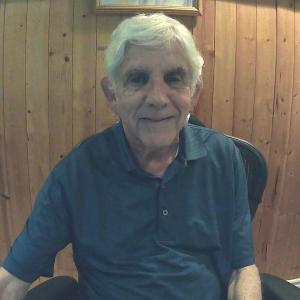
Reviewer & Author Interviewer, Norm Goldman. Norm is the Publisher & Editor of Bookpleasures.com.
He has been reviewing books for the past twenty years after retiring from the legal profession.
To read more about Norm Follow Here
.png)
In Bookpleasures' riveting interview, acclaimed novelist and former diplomat Otho Eskin delves into his latest thriller, Black Sun Rising, the gripping fourth book in the Marko Zorn series.
Eskin unveils the real-world experiences and political insights that shaped his portrayal of a resurgent Neo-Nazi threat lurking beneath Washington, D.C.'s surface.
Discover how his multifaceted career informs Zorn’s unique character, explore the tense cat-and-mouse chase through secret tunnels, and get a glimpse into the chilling conspiracies that push the nation to the brink.
For readers of taut political thrillers with richly complex heroes, this conversation offers a compelling look behind the scenes of Eskin’s darkly thrilling world.
Bookpleasures.com welcomes as our guest Otho Eskin, a distinguished novelist, playwright, and former diplomat whose diverse career has spanned over two decades in the United States Foreign Service—with postings ranging from Damascus and Belgrade to Reykjavik and East Berlin—along with key roles in international negotiations on the law of the sea and space exploration.
Since retiring from government service, Otho has turned his talents to fiction, launching the acclaimed Marko Zorn series, which blends razor-sharp suspense with timely political intrigue.

Today, we’ll be discussing his latest thriller, Black Sun Rising, the fourth installment in the series, in which Washington, D.C., homicide detective Marko Zorn confronts a resurgent Neo-Nazi movement and a sinister conspiracy that threatens to plunge the nation into chaos.
Norm: Good day, Otho, and thank you for joining us.
Your protagonist, Detective Marko Zorn, is a former Army Ranger homicide detective who chooses not to carry a gun. What inspired this unique trait, and how does it reflect his psychological complexity?
Otho: I wanted Marko Zorn to be a different kind of detective. Not a traditional gun-carrying cop but a complicated man with a complicated background. The specific reasons for him not carrying are explained in Black Sun Rising: He is afraid of his reaction in a moment of danger, and he is deeply opposed to killing.
Norm: You’ve had careers in diplomacy and creative writing. How do your diplomatic skills, especially discretion and nuance, influence your thriller writing that features clear action and moral stakes?
Also, do your experiences as a playwright shape how you structure your novels or visualize scenes cinematically?
Otho: I don’t think discretion and nuance comes into the writing of thrillers at all. In fact, it has been quite liberating being able to write and say whatever I want.
My experience as a playwright has helped me tremendously since I am able to write dialogue and all exposition is in what people say. I do visualize each scene very carefully and in great detail.
Norm: Black Sun Rising hints at a traumatic past event involving Zorn’s sister. Did you develop this backstory before writing, and can readers expect to learn more in future books?
Otho: I developed the outlines of this backstory when writing the first thriller novel in the Marko Zorn series, The Reflecting Pool. I don’t think there is much more to say about Marko’s traumatic experience involving the murder of his sister.
Norm: You served over twenty years in the Foreign Service, including time in East Berlin during the Cold War. How did your exposure to authoritarian regimes and intelligence work influence your depiction of the Neo-Nazi group in Black Sun Rising?
How do real-world encounters with violence shape your approach to thriller fiction?
Otho: In my experience as a Foreign Service Officer, I served in several countries with authoritarian regimes: Syria, the German Democratic Republic, and former Yugoslavia. Each was governed by a one-man ruler.
I observed the effects of violent regimes on their citizens. And although I was not a victim of violence myself (as a diplomat, I was able to escape political violence), I did observe firsthand a public execution, which has stayed with me ever since.
The executed man may have been guilty of espionage, but he did not deserve his fate. I need to clarify that I was not involved in any kind of intelligence work, although the East German Secret Police (Stasi) included me in a publication claiming that I was part of the CIA. I was not.
I was able to write about how the neo-Nazi movement in Black Sun Rising was almost able to overthrow the US government since I experienced firsthand an attempted coup in Syria. Working as a Diplomat and Foreign Service Officer for over twenty-five years, I came to understand the inner workings of governments and this has served me well. The beauty of writing thriller novels is that one can let one’s imagination run wild—whereas in real life I abhor any kind of violence.
Norm: The climax takes place in Washington DC’s underground tunnels, sewers, and hidden waterways. What research did you undertake to map these locations?
Did you explore them yourself, and are there other secret places in DC you plan to feature in future novels?
Otho: I never explored the Washington underworld myself, but I did find maps of tunnels and ancient rivers. The rest of it was imagination. My next novel takes place in a cathedral in Washington and although the building itself is not a secret, much of what goes on inside is.
Additionally, I am plotting another Marko Zorn thriller in the series, but this time Marko travels overseas to prevent a crime.
Norm: The twist of Black Sun being twin brothers competing as rivals is striking. Why did you choose two antagonists instead of one, and how does their backstory as former conjoined twins deepen their relationship?
Did you research twin psychology to develop this dynamic?
Otho: I must confess that I did no research whatsoever on the psychology of twins, although I did some research on identical twins. I wanted to explore how evil can make two different appearances in two different people.
It was also exciting to know that while everyone was looking for one enemy, there were in fact two! This kept Marko and the audience on their toes. When you ask about the former conjoined twins and their backstory forming their relationship—it seems that the only thing that deepened was their hatred for one another.
Norm: The novel vividly portrays how young men get radicalized online. What research did you do on modern Neo-Nazi and white supremacist movements?
How do you balance showing their humanity while condemning their ideology?
Otho: I read several books about the resurgence of neo-Nazis and fascism in today’s political scheme and, of course, I have been following it in the press. Beyond that it is all my political imagination.
All of the characters, despite their ideology, are human beings with complicated backgrounds that have to be taken into account.
Norm: The story’s Nazi-era nerve gas recovered by extremists, adds chilling historical depth. Is this based on real history or fictional? How much expert consultation shaped the technical details, such as the nerve gas delivery system?
Otho: The original nerve gas Zyklon B was used by the Nazis in the camps to murder Jews, their enemies, gypsies, and anyone they saw as a menace or threat to society. Zyklon C does not exist as far as I am aware—I invented it and the delivery system.
Norm: Mrs. Davenport is a morally ambiguous and controversial character with a complex relationship with Zorn. Is her reality intentionally ambiguous?
Were you concerned readers might struggle with Zorn’s intimacy with someone who kills his partner?
Otho: I believe that Mrs. Davenport is morally evil and has no redeeming features. Zorn struggles with his attraction to Mrs. Davenport. It is part of his complicated personality. I believe that readers are smart enough to understand the complexity in this relationship.
Norm: Professor Fairfield’s warnings about fascism and oligarchic power feel politically charged. How comfortable are you blending overt political commentary with fiction?
Do you see the scenario of wealthy elites buying the country as metaphor or a realistic threat?
Otho: I am totally comfortable combining a work of fiction with contemporary political developments in this country. Fairfield expresses my concerns precisely. In this book, he is me! I see the risk of the super-wealthy buying the country as a very real threat and not a metaphor at all.
Norm: The novel features multiple agencies—DC Police, FBI, Secret Service, German intelligence, Homeland Security—all with competing agendas. How did you manage these complex interactions, and what does this suggest about contemporary counter terrorism?
Also, how consciously did you create strong female authority figures like Carla Lowry and Kelly Flynn in this male-dominated genre?
Otho: My treatment of these competing agencies is based on years of observation and experience with federal agencies who are often in competition with one another to achieve different objectives. I tried to make this realistic. In my experience, there are no secrets in Washington. This competitive atmosphere weakens the government’s anti-terrorist activities.
I pride myself in creating strong female authority figures. Even as a playwright, several of my plays featured strong female protagonists. I admire strong women. Women are not necessarily admirable—don’t forget Mrs. Davenport!
Norm: Where can readers learn more about you and Black Sun Rising?
Otho: Please have your readers check out my website OthoEskin.com for information on Black Sun Rising and where you can buy it.
Norm: As we conclude, Black Sun Rising leaves key threads unresolved—Bobby Grant’s fate, Mrs. Davenport’s survival, and Zorn’s fugitive status. What can you share about future Marko Zorn novels?
How has the character evolved, and will we learn more about his reluctance to carry a gun?
Otho: Bobby Grant will more than likely be murdered by his co-conspirators, Mrs. Davenport’s future is indeed a mystery, and thankfully Marko Zorn is no longer a fugitive since Carla clears his record. I am currently working on two future Marko Zorn novels where we learn more about Marko.
Norm: Thanks once again and good luck with all of your endeavors